
Committee advances Disability and Aging budget; members press department on DSP pay, Katie Beckett slots and adult changing tables
Get AI-powered insights, summaries, and transcripts
Subscribe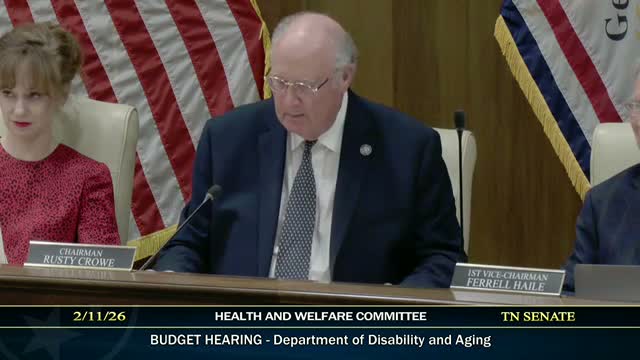
Summary
The Senate Health & Welfare Committee approved the Department of Disability and Aging budget after hearing from Commissioner Brad Turner on capital projects, staff shortages and program limits for the Katie Beckett waiver. Senators pressed the department on direct support professional wages, bed capacity under Jillian's Law and grant-funded adult changing tables.
Commissioner Brad Turner presented the Department of Disability and Aging’s budget and program updates, highlighting capital projects (three facilities with total expenditures around $127 million to date, ARPA-funded) and operational adjustments that met a required 1% reduction.
Turner and his staff described provider challenges, noting direct support professionals (DSPs) remain essential and that turnover and wages are ongoing concerns. In response to a question about the DSP hourly rate, the department reported a figure (as stated in testimony) of "1572" as the current rate metric discussed during the hearing. Turner said the department continues to advocate for DSP compensation and provider support and had pursued non-pay supports such as engagement, coordination and technical assistance.
On behavioral health and forensic placements tied to 'Jillian’s Law,' the department said facilities previously had limited staffed beds but now report being fully staffed for the beds associated with that statute and have capacity aligned with court referrals. Regarding the Katie Beckett waiver, Turner said about 4,700 participants currently receive services and that without additional funding the program would be at capacity; he estimated roughly 250–300 people per month inquire about eligibility but cannot be added without new slots.
The department also reported significant uptake for adult changing-table grants (about half of a $1 million allocation expended or obligated) and described outreach to eligible businesses and state rest-stop installations. Turner highlighted Silver Alert kits that have helped more than 500 families in five years.
After discussion, the committee voted to approve the department’s budget and forward it to the Finance Committee. Senators requested follow-up information on waitlists, certification for beds, and program spending and monitoring.