Chief Medical Examiner warns of imminent shortfall, asks legislature for $4.5 million recurring
Loading...
Summary
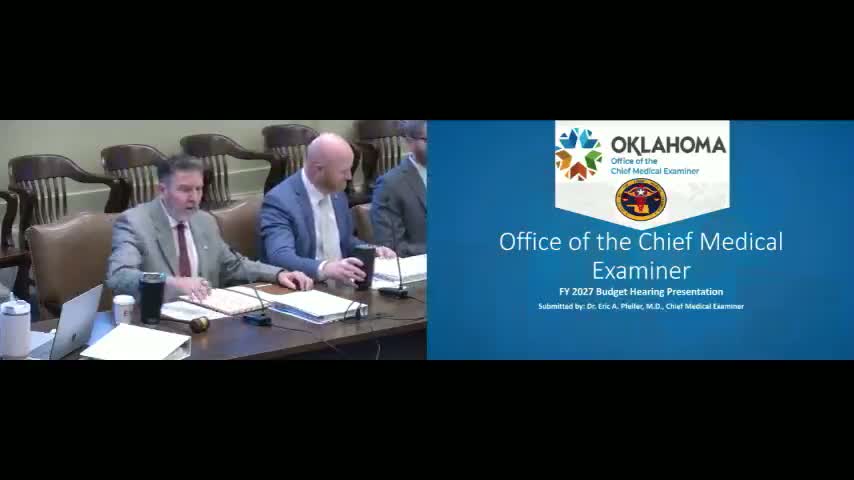
Chief Medical Examiner Dr. Pfeiffer and operations director Timothy Dwyer told the appropriations subcommittee that accreditation and expanded staffing have improved turnaround times but left the office financially strained; they requested $4.5 million recurring and said the agency could "run out of money" within weeks of the fiscal year if not funded.
Dr. Michael Pfeiffer, Chief Medical Examiner, told the Senate Appropriations Subcommittee on Public Safety and Judiciary that the Office of the Chief Medical Examiner has reached full accreditation from the National Association of Medical Examiners after expanding staff from five forensic pathologists a decade ago to 18 today, and that the office is seeking $4.5 million in recurring state funding to maintain operations.
The request covers professional staff pay (physicians, anthropologists and toxicologists) and roughly $1 million in operational expenses. Pfeiffer and his operations director, Timothy Dwyer, said improvements include faster forensic testing and cremation-permit processing; Dwyer said 99 percent of toxicology cases are completed within 90 days and funeral-home permits are being returned in about six hours instead of days. "With a flat budget, we're gonna run out of money in August," Pfeiffer said, adding later, "that would be a catastrophic collapse of the agency" if additional appropriations are not provided.
Why it matters: The medical examiner's office performs legally required death investigations and issues cremation permits; the agency said fuller staffing and faster turnaround reduce costs to other agencies and speed family access to final arrangements. The office also cited one-time equipment needs and the need for more toxicology lab space; its cash reserves fell from roughly $10 million to about $2.5 million over recent years.
Details and context: The department reported that its expanded in-state forensic staffing cut the workload per physician and increased capacity for rural coverage across the state's 77 counties. The office said a new approach to skeletal identifications reduced reliance on external genetic testing and saved partner agencies about $23,000 in at least one case. The presentation also noted rising supply and transport costs and identified replacement cycles for expensive diagnostic equipment.
What officials asked and what they said in response: The offices request of $4.5 million recurring includes salary adjustments to keep pay competitive with neighboring states and service-area travel and transportation costs. When asked how soon the agency would exhaust funds without an appropriation, Pfeiffer said the agency would likely run out within "4 to 6 weeks after the new fiscal year starts" and that staff layoffs would be unavoidable absent funding. Committee members said they would consider the request in the full appropriations process.
Next steps: The subcommittee will weigh the medical examiners request as it compiles recommendations for the full appropriations committee. No formal vote was recorded during the hearing.