Get Full Government Meeting Transcripts, Videos, & Alerts Forever!
Get email alerts on the Wildland Firefighting topic
No spam. Unsubscribe anytime.
Wyoming House advances package to bolster wildland firefighting, adds new crews and benefits
Summary
Lawmakers passed a group of bills in Committee of the Whole aimed at recruiting and retaining wildland firefighters, including new paid-leave and hazard-pay provisions, additions to the firefighter retirement plans, creation of a state wildland fire module, and funding for smoke-buster positions and equipment.
Lawmakers in the Wyoming House moved a multi-piece package this week designed to strengthen the state’s wildland firefighting capacity, passing several bills out of the Committee of the Whole.
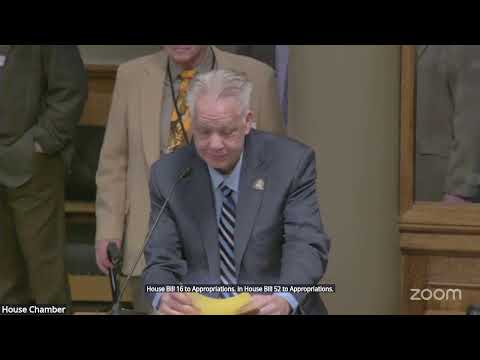
Representative Sherwood, explaining House Bill 34, said the bill corrects drafting and expands the guard firefighter retirement plan to include four full-time seasonal (nine‑month) positions, increasing plan contributions and helping the pension reach full funding sooner. "We are losing our hardworking men and women who serve us to other states or other agencies," Sherwood said, arguing change is needed to remain competitive.
Sponsors described House Bill 35 as the companion measure authorizing hazard pay and paid leave for firefighters, and Representative Harrelson presented a committee amendment to decouple the state policy from federal standards so Wyoming can set its own time‑off and hazard‑pay rules. "We didn't want it to be a situation where the federal government changed that standard and pulled the state along in tow," Harrelson said.
House Bill 36 would create a permanent state 'wildland fire module' to place a professional ground crew on fires when local volunteer capacity is exceeded. Harrelson highlighted the module's makeup — 12 total employees: two full‑time, two nine‑month, and eight six‑month hires — and said the module aims to cover much of the fire season and reduce reliance on exhausted volunteers after 72 hours.
A separate bill, House Bill 106, adds two smoke‑buster module leader positions and roughly $499,000 for equipment to restore capacity lost during the pandemic. Sponsor Harrelson told members the smoke‑buster program is a joint effort between State Forestry, the Office of State Lands and Investments and the Department of Corrections and that restoring leadership depth is essential for reliable inmate hand‑crew operations.
Supporters framed the package as recruitment and retention policy: specialized retirement benefits, hazard pay and paid leave, and staffed ground modules are intended to keep trained personnel in state service rather than losing them to federal agencies or other states. Opponents asked why some elements were statutory versus budgetary; sponsors said the funding appears in the budget but statute ensures the programs are "baked in" and clarifies roles and responsibilities.
All four bills were reported by Committee of the Whole with committee amendments where noted. The committee adopted the amendments and advanced the bills for further consideration as appropriate.