Get Full Government Meeting Transcripts, Videos, & Alerts Forever!
Get email alerts on the Legislation topic
No spam. Unsubscribe anytime.
Wyoming House introduces dozens of bills in brisk session; many fail two‑thirds threshold
Summary
On Feb. 11, 2026 the Wyoming House heard and voted on a large slate of first‑reading bills. Several were introduced and assigned to committees, while numerous proposals failed to meet the two‑thirds vote needed for introduction. The day included debates on health, water, energy, and constitutional protections.
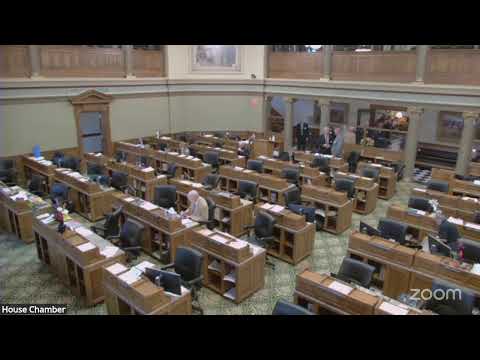
The Wyoming House of Representatives spent its third day of the 60th Legislature’s budget session considering a packed list of first‑reading bills, introducing several measures and rejecting others that failed to reach the two‑thirds threshold required for introduction.
House leaders began the morning with roll call and procedural business and then moved through bill introductions and debate. Sponsors summarized their proposals in two‑minute primers; most items then went immediately to a roll‑call vote on introduction.
What passed introduction and where they go
- House Bill 147 (property tax exemptions): Sponsored by Representative Locke, the bill clarifies that certain property‑tax exemptions tied to a people’s initiative will sunset if the initiative is enacted. Introduced by the House (60 aye, 1 no, 1 excused); assigned to Committee 3 (Revenue).
- House Bill 115 (cardiac events planning and training in schools): Sponsored by Representative Byron, the measure would require schools to adopt cardiac response plans, keep AEDs accessible and train staff in CPR/AED so as to increase survival rates in school cardiac emergencies. Introduced (52 aye, 9 no, 1 excused); assigned to Committee 4 (Education).
- House Bill 141 (Fifth Amendment Protection Act): Sponsored by Representative Bair, who framed the bill as protecting property rights against local mitigation requirements he described as takings. The bill passed introduction (51 aye, 10 no, 1 excused) and was assigned to Committee 2 (Appropriations).
- House Bill 128 (enhanced oil recovery severance tax exemption): Sponsored by Representative Tarver to support tertiary oil recovery in legacy fields. Introduced (58 aye, 3 no, 1 excused); assigned to Committee 9 (Minerals).
- House Bill 129 (Expanding Physicians Access Act): Sponsored by Representative Wasserburger to create a provisional licensing pathway for internationally trained physicians; introduced unanimously with two members excused (60 aye, 2 excused); assigned to Committee 10 (Labor).
- House Bill 130 (Second Amendment Protection Act amendments): Sponsored by Representative Wharfe to add civil and criminal provisions and to clarify enforcement limitations; introduced (50 aye, 10 no, 2 excused); assigned to Committee 2 (Appropriations).
Notable bills that failed introduction (two‑thirds required)
Several high‑profile measures failed to obtain the two‑thirds affirmative vote needed for introduction despite debate on their merits:
- House Bill 37 (nonpartisan county officials): failed (6 aye, 55 no, 1 excused). - House Bill 47 (duty to assist during emergencies): failed (22 aye, 39 no, 1 excused). - House Bill 63 (Medicaid nursing‑home reimbursement +5%): failed (27 aye, 34 no, 1 excused). - House Bill 64 (enhanced Medicaid reimbursement for maternal services): failed (27 aye, 34 no, 1 excused). - House Bill 74 (public schools to provide menstrual products): failed (22 aye, 39 no, 1 excused). - House Bill 82 (highways investment using trust fund): failed (29 aye, 31 no, 2 excused). - House Bill 99 (Wyoming Veterans Museum capital construction): failed (20 aye, 41 no, 1 excused). - House Bill 116 (statement that destruction of water is not a beneficial use): failed (39 aye, 21 no, 2 excused). - House Bill 131 (limits on government use of public funds for association lobbying): failed (27 aye, 34 no, 1 excused).
What lawmakers said
On Medicaid nursing‑home reimbursement, Representative Clauston said, “We are not paying what we need to keep our nursing homes open,” arguing a 5% increase could help preserve rural facilities and employers. Representative Bair countered that other funding vehicles, including the rural health transformation fund, should be considered.
On property and housing policy, Representative Bair cited constitutional language: “The Fifth Amendment … property shall not be taken from the public for public use without just compensation,” framing HB141 as protecting private property rights against local mitigation requirements.
Procedural note and formal protest
During debate on HB141 Representative Rodriguez Williams registered a formal protest under House Rule 8‑5, stating that during the debate an allegation was made that “checks were distributed on the floor,” language she said alleged improper behavior and warranted an entry in the journal. The Speaker directed that the protest be entered into the House journal.
What’s next
Bills that were successfully introduced will be heard in their assigned committees (Revenue; Education; Appropriations; Minerals; Labor) where members will receive testimony and consider amendments. Many other measures will require additional drafting or coalition‑building before a future introduction vote. The House recessed for committee work and will continue with committee of the whole and additional business this afternoon.