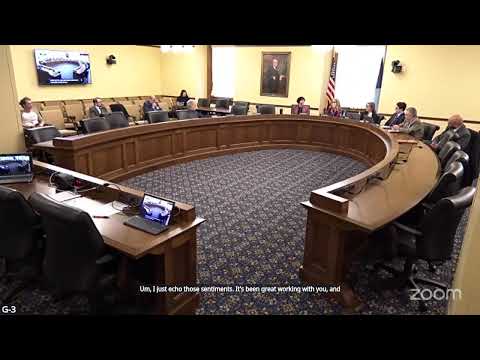
Rep. Feist outlines bill to ban reverse-location and reverse-keyword search warrants
Loading...
Summary
Representative Feist presented a bill (recorded in the hearing as HF103) that would prohibit government use of reverse-location and reverse-keyword search warrants and create a civil cause of action; members discussed court cases and enforcement implications.
Representative Scott Feist presented a bill described in the meeting record as HF103 that would prohibit government entities from requesting or obtaining reverse-location information and reverse-keyword search warrants and would create a civil cause of action for affected individuals.
Representative Feist told the commission the bill aims to address an investigative technique that can sweep large numbers of innocent people into a law-enforcement net. "It would prohibit government entities from requesting or obtaining reverse location information, which is...it would create a civil cause of action," Feist said when introducing the proposal. She clarified the bill covers both reverse-location warrants and reverse-keyword search warrants — where law enforcement requests data showing who searched for a specific phrase in a time window.
Members asked whether specific instances motivated the legislation. Feist cited a hit-and-run example in which everyone who searched the term "hit and run" was swept into an investigation, and she referenced expert testimony indicating sharp increases in the technique's use: "in 1 jurisdiction...it was like a 1,300% increase...in Minnesota, I believe it was, like, a 686% increase in the use in a recent 2 year window." Those figures were presented by Feist as illustrative evidence; commissioners and testifiers did not provide underlying source documents in the meeting record.
The chair noted there is also an active Supreme Court case concerning reverse-location warrants and said Minnesota Attorney General Keith Ellison "is probably gonna be bringing something state on the state level on these." Members discussed whether the Legislature should act before—or wait for—any judicial decisions.
Representative Hudson and others raised the practical question of whether banning the warrant type is preferable to more targeted safeguards. The commission did not vote on the bill at the meeting and took no formal action; members suggested further study and committee briefings could inform next steps.
Next steps: Feist and other commissioners said they will coordinate on possible bills during session and brief appropriate committee chairs and colleagues.