Get Full Government Meeting Transcripts, Videos, & Alerts Forever!
Get email alerts on the Police Fire Salary topic
No spam. Unsubscribe anytime.
Milwaukee council committee pauses effort to add recruitment flexibility for fire chief amid questions about police‑chief pay
Summary
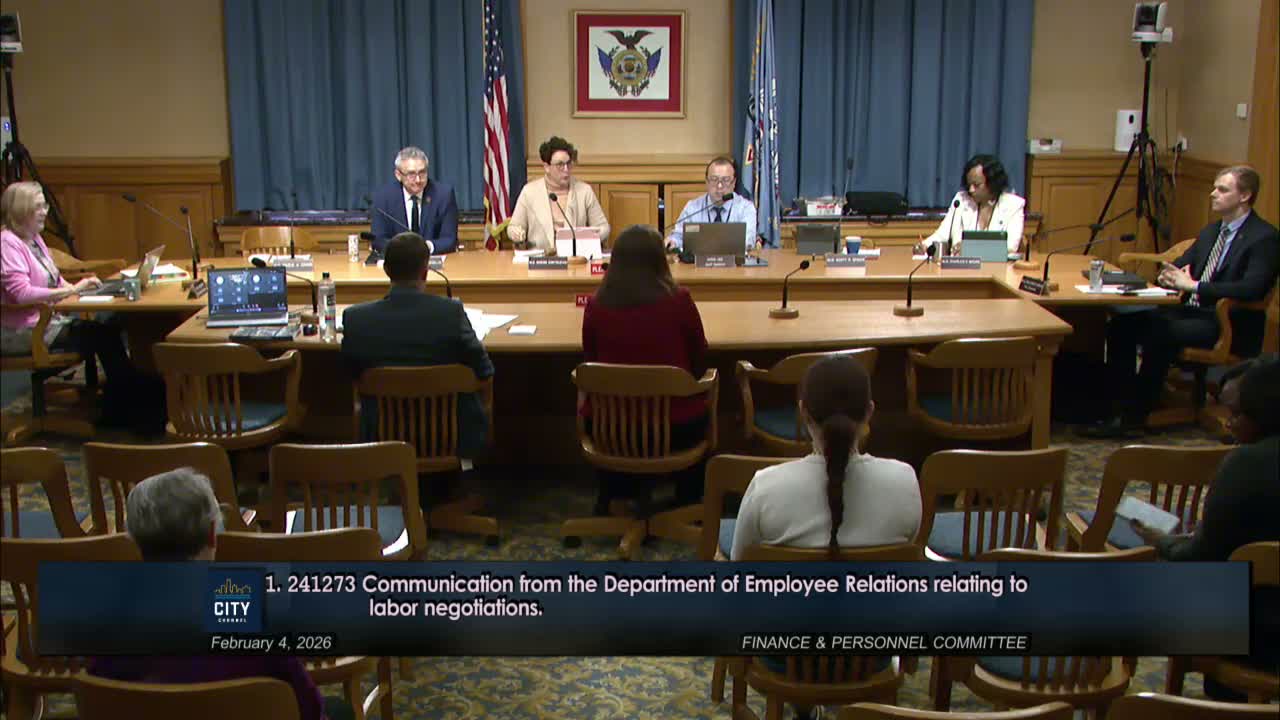
A Finance & Personnel Committee meeting Tuesday halted action on a classification file seeking parity in a recruitment footnote for the fire chief after lengthy debate about a prior police‑chief pay increase, transparency on fiscal impact and which body can set salaries.
The Finance & Personnel Committee on Feb. 4 held to the call of the chair a proposal to add recruitment flexibility for the fire chief while members pressed for clearer fiscal details about a prior, large increase to the police chief's salary.
Alderman Charlyn Moore, sponsor of the classification file, said the change was intended to provide equity between the police and fire chiefs. "There's been a lot of back and forth," Moore said, and she asked the Department of Employee Relations and Fire and Police Commission representatives to explain how the current footnote and range language had developed.
Department of Employee Relations representatives explained that the item before the committee clarifies authority and provides flexibility but does not itself increase salaries. "The clarification is this action allows for the flexibility. It does not create the increase," Jackie Carter, a DER representative, told the committee; she said any future increase would require a separate action.
Members objected that the committee lacked information on the potential fiscal ripple effects if recruitment authority allowed hiring near the top of a range. "The salary for the police chief was raised unilaterally by the Fire and Police Commission from $1.83 to $2.43, which is, like, a 33% increase," Alderman Speicher said, calling that a "ginormous increase" and urging fuller fiscal analysis before changing footnote language that could authorize similar flexibility.
Miriam Horowitz, chair of the Fire and Police Commission, framed the issue as one of management authority as well as equity: the commission hires and evaluates chiefs and, she said, needs salary tools tied to performance. "If we want to be able to impact performance for the Chiefs, I think we have to have some ... authority for their salary," Horowitz said.
Committee members sought a formal city attorney opinion about the legal effect of prior motions and the relationship between the executive pay plan, footnotes in the salary ordinance, and existing recruitment flexibility. Budget office and DER staff explained that some earlier pay‑plan actions removed recommended minimum recruitment rates but left a preexisting police‑chief footnote untouched, producing differing interpretations across departments.
After extended discussion, Alderman Moore moved to hold the file to the call of the chair so the committee could obtain clearer fiscal analysis and a possible formal opinion from the city attorney. The motion passed without recorded objection.
The committee also signaled interest in reopening and clarifying the larger executive pay plan and associated footnotes so the council can reduce ambiguity about recruitment authority and budgetary control.
What happens next: the file is held to the call of the chair pending supplemental fiscal analysis and legal guidance; committee members indicated they expect DER, the comptroller and the city attorney to return with clearer documentation before any change that could affect pay or pensions.