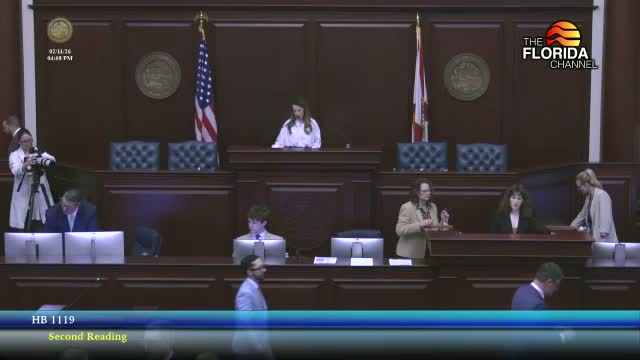
Florida House adopts HB 1119 defining "materials harmful to minors" after lengthy debate
Loading...
Summary
The Florida House passed HB 1119 on Feb. 11, 2026, a bill that revises the law on materials harmful to minors in public schools and libraries after hours of debate and multiple failed amendments. The final vote was 84–28. Supporters said it protects children; opponents warned of expanded censorship and litigation risk.
TALLAHASSEE — The Florida House of Representatives on Feb. 11 passed House Bill 1119, a measure that narrows and clarifies what state law calls “materials harmful to minors” and tightens state oversight of public-school library content, after extended debate and a series of failed amendments.
Representative Bankston, the bill sponsor, said the measure is intended to close a legal loophole that has allowed explicit, pornographic material to reach minors. "This legislation ... seeks to close the loophole regarding materials harmful to minors," Bankston told colleagues, arguing the statute will let districts differentiate between material appropriate for adults and that which should be off-limits to children.
Supporters framed the change as a child-protection measure, saying the bill mirrors language drawn from the Ginsburg standard and gives school districts parameters for evaluating sexually explicit or obscene material. Bankston also emphasized that the bill is not aimed at "classical literature" or curricular works.
Opponents countered that the bill sweeps too broadly and removes essential safeguards. Representative Eskamani said the measure would expand a system that has already led to widespread book removals and urged colleagues to consider the effect on classroom instruction and students’ access to literary and historical works. "We've already seen historic literature pulled from shelves," Eskamani said during debate, urging colleagues to resist lowering long-standing constitutional standards.
Lawmakers debated numerous amendments seeking to narrow the bill or add procedural safeguards. Representative Gant proposed an amendment to create a transparent online database of objections and to preserve parental control during review; Representative Aristide offered language to restore the Miller-based "whole work" review; Representative Bartleman sought limits on repetitive objections and removal of a costly special-magistrate appeal process; Representative Eskamani proposed reinserting language that requires consideration of literary, artistic, political or scientific value. Each amendment was debated on the floor and failed to gain adoption.
Several members raised legal concerns tied to ongoing litigation: Representative Harris and others noted federal court rulings earlier that found parts of prior statutory language unconstitutional and cautioned that expanding the statutory framework while cases are on appeal could expose districts and taxpayers to new litigation and conflicting obligations. Sponsors replied that the bill deliberately seeks to clarify state authority and expects legal challenges to be resolved in favor of protecting minors.
After structured debate, the House voted on final passage. The clerk announced the tally as 84 yeas and 28 nays, and the bill passed the House. The measure will now proceed to the Senate for consideration.
Why it matters: The bill attempts to tighten statutory authority over school materials and reduce what supporters called a "loophole" in applying adult-obscenity tests to minors. Critics say the statutory language is vague in places (for example, the undefined use of the word "predominantly"), risks chilling legitimate educational material, and could increase litigation costs for school districts already defending objections in federal court.
What’s next: With House passage, HB 1119 moves to the Florida Senate for consideration. Given the number of failed floor amendments and vocal concerns recorded on the House floor, additional changes or legal challenges are likely if the Senate advances the measure.
Quotes from the floor: "This legislation ... seeks to close the loophole regarding materials harmful to minors." — Representative Bankston, bill sponsor. "We've already seen historic literature pulled from shelves ... this bill moves us further away from long-standing constitutional standards by preventing decision-makers from considering a book's full literary, artistic, political or scientific value." — Representative Eskamani.
Ending: The House adopted HB 1119 by 84–28. The bill will be referred to the Senate; no date for the Senate committee hearings was reported on the House floor on Feb. 11.