
Town hall draws hours of public testimony on leash laws, impoundment, spay/neuter and FOGA contract
Get AI-powered insights, summaries, and transcripts
Subscribe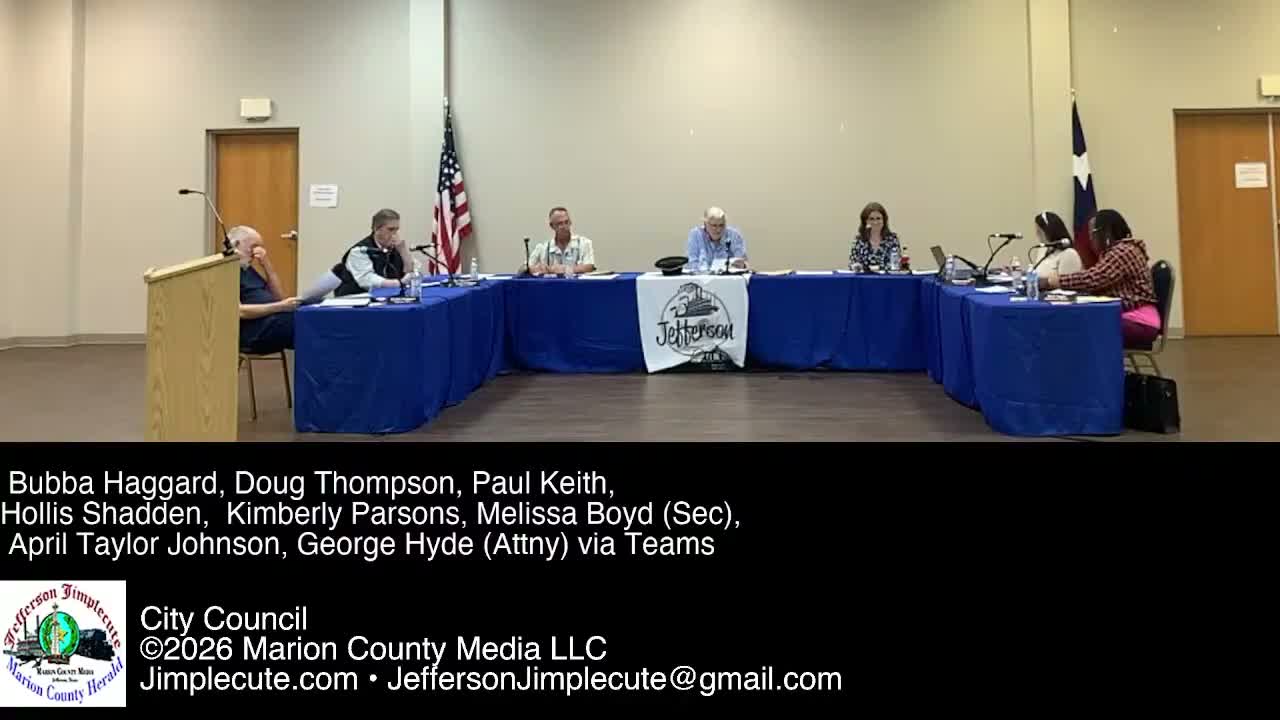
Summary
At a Marion County town-hall-style session, residents, animal-control officers and rescue volunteers urged stronger leash enforcement, more impound/quarantine capacity, expanded spay/neuter and microchipping programs, and clearer contract terms and accountability for the nonprofit that handles much of the city's animal work. No ordinance changes were voted on tonight.
City council members held a town-hall listening session focused on a broad package of proposed animal-control measures, drawing hours of public testimony from residents, animal-control officers, rescue volunteers and attorneys. Speakers repeatedly pressed for clearer leash rules and enforcement, more local quarantine and impound capacity, incentives and limits for breeding and ownership, and a defined contract and funding terms with Friends of Jefferson Animals (FOGA), the nonprofit that provides much of the city’s animal-response capacity.
"It's very important for a service dog team," said Mickey Moore, describing how roaming dogs can ruin a seizure‑alert dog's ability to function; Moore said his daughter and her service dog sometimes must wait in the car when other dogs roam off-leash. Animal-control officer Skylar Clark described how so-called "pack" aggression can occur with as few as two dogs and recounted a mauling in which one animal had to be euthanized on scene.
Chief Perez and animal-control staff told the council the current ordinance's language leaves too many enforcement ambiguities: officers often issue warnings and face limited options for impoundment, and the city lacks a dedicated quarantine facility. Under Texas law, an animal that bites a person typically must be quarantined for 10 days, which requires either local kennel capacity or an inter‑jurisdictional contract to hold animals in another county. Marshall's facility reported four dog and six cat quarantine kennels, and staff said kennels are frequently full during high-call periods.
Rescue organizations urged stronger spay/neuter programs and ownership limits. Dina Carroll and others described high intake and transport volumes — Carroll said she has sent roughly 1,500 animals to out‑of‑state partners over five years — and advocated for Longview‑style intact‑spay/neuter ordinances that combine fines with grant-funded assistance. FOGA and other volunteers also pressed for microchipping; Skylar Clark noted a BISSELL-funded microchip program launched last year that has improved return-to-owner outcomes and argued microchips are more reliable than GPS collars.
Council members and speakers debated the city's draft contract with FOGA. Steve Shaw, an attorney for the nonprofit, told council the proposed contract draft was "overly controlling and oppressive" for the funds contemplated and recommended using Marion County’s existing contract as a template. Council members asked for clearer reporting and accounting language; FOGA representatives said the nonprofit provides a large share of frontline animal services at a fraction of the municipal cost and urged flexibility in contracting.
Speakers also discussed feral‑cat management, with Friends of Jefferson Animals detailing a trap‑neuter‑return program and proposing a colony‑registration system similar to Kilgore’s model. Volunteers said TNR has reduced colony sizes in downtown locations and that testing for FIV/FeLV and vaccinating and returning healthy cats is a humane population-control strategy.
No ordinances were adopted or votes taken on substantive changes during the meeting. Council members said they will take the public testimony under advisement, involve attorneys in drafting clearer enforcement language, and consider contract revisions and funding options at future meetings.