
Jefferson town hall hears repeated calls to tighten leash, impound and breeding rules; no action taken
Get AI-powered insights, summaries, and transcripts
Subscribe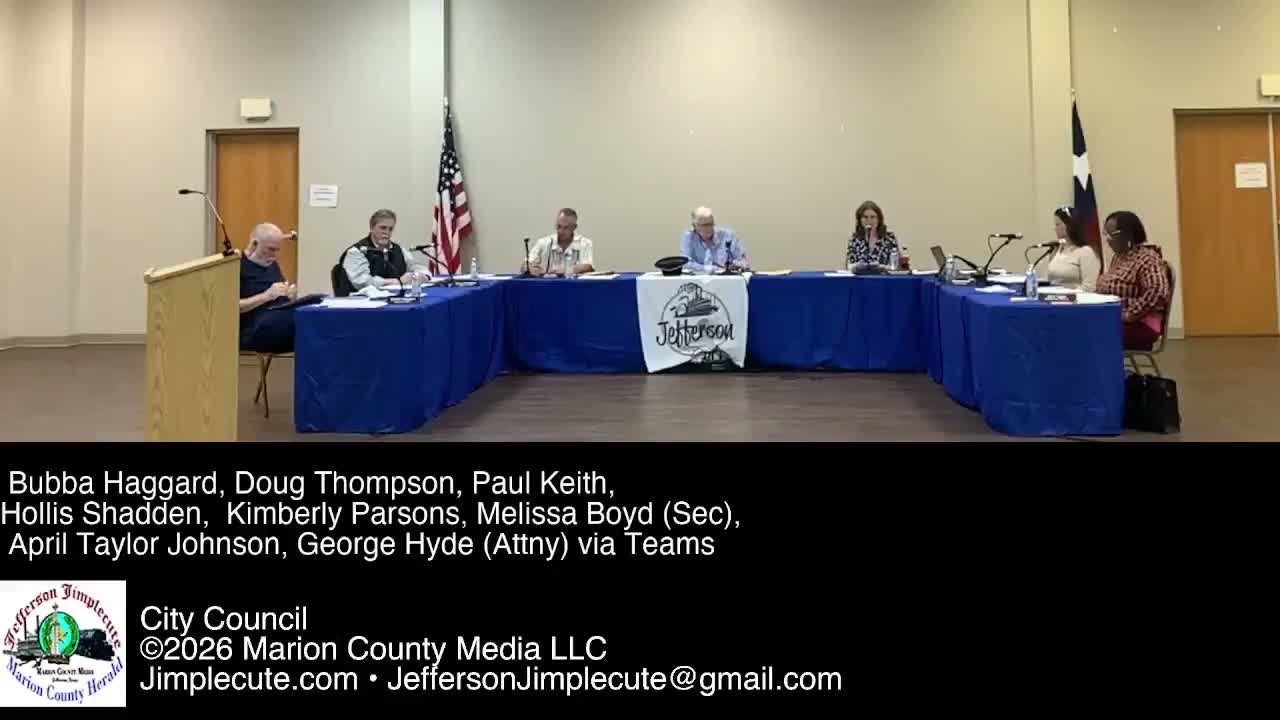
Summary
At a town-hall meeting on animal regulations, residents and animal-control officers urged a rewrite of Jefferson’s leash law, solutions for impound and quarantine capacity, expanded spay/neuter programs, and stronger enforcement; council heard testimony but did not adopt changes.
Jefferson’s city council hosted a town-hall session on animal regulations that centered on revising the leash law, addressing the city’s lack of an impound/quarantine facility, and expanding spay/neuter and microchip programs. The council opened the meeting as a listening session and took no formal action.
Several residents told the council loose dogs have restricted their ability to walk and exercise safely. “When we’re out in public, he gives her a warning prior to a seizure,” said Mickey Moore, who testified about the importance of a service dog for his daughter and described occasions when they have had to wait in the car because loose dogs made outings unsafe. Animal-control officers and rescue volunteers warned that the ordinance, as written, allows owners to rely on voice recall rather than physical restraint. “As our ordinance stands … as long as he can come to her when she calls, then she’s well within her purview to have him off that leash anywhere she goes in the city limits,” said Dina Carroll, a longtime rescue volunteer.
Marshall animal-control officer Skylar Clark recounted a mauling case in which a mail carrier was bitten “36 times,” and said pack-like aggression can occur with as few as two dogs. Chief Perez told the council the city’s ordinance is outdated and contains ambiguous language that complicates enforcement; he said officers often issue warnings and lack clear procedures and holding capacity when an animal must be impounded.
Speakers and staff described gaps in local quarantine capacity under Texas rabies rules. Officer Greg Kelding explained that a bite generally triggers a 10‑day rabies quarantine and that if an animal is not vaccinated it must go to an approved quarantine facility; testing for rabies requires euthanasia and laboratory submission of the head. Marshall’s rabies-control facility capacity was described as limited (examples in the session cited four dog and six cat quarantine spaces), and speakers urged the council to seek inter‑county contracting as a practical interim solution.
Rescue groups described the scale of the population and transport work they do. Friends of Jefferson Animals and partners said they have transported animals to northern rescue partners (one speaker said roughly 1,500 animals were sent to a New York partner over five years) and that transports can cost $3,000–$4,000. Speakers argued that spay/neuter (and registration/microchipping) is the necessary long-term solution to overpopulation; Marshall’s microchip program, supported by a BISSELL grant, was offered as an effective model to return lost animals to owners.
Volunteers and veterinarians described trap‑neuter‑return (TNR) practices for feral cat colonies, testing for FIV/FeLV before altering and returning cats, and the “vacuum effect” (new cats move into cleared areas if reproduction is not addressed). Rescue volunteers said they count roughly 28 active colonies within town limits and offered to help coordinate registered colony caretakers and vet appointments.
Several residents raised liability and public-health concerns ranging from downtown food-service access (whether only service animals may enter establishments that handle food) to reports of intentional poisoning; the council noted Chapter 14 section 4 of the city code prohibits placing poison to injure domestic animals.
The most recent development: council members heard extensive testimony and staff technical details but did not adopt ordinance changes at the meeting. Council members said they will work with city attorneys and staff to draft clearer ordinance language, explore quarantine/impound contracts and capacity solutions, and consider funding options for spay/neuter and microchip programs. The session ended with no vote on a new animal ordinance and with the council planning further review and possible action at a later meeting.