Marquette County pursues 9‑key watershed plan for Buffalo Lake with $20,000 seed funding
Loading...
Summary
Marquette County staff told residents and DNR officials they have secured a $10,000 grant matched by a $10,000 Lake District contribution to prepare a 9‑key‑element watershed plan for Buffalo Lake and Good Earth Creek, using modeling and targeted outreach to win further implementation funds.
Marquette County conservation staff said Tuesday the county has begun drafting a 9‑key‑element watershed plan aimed at reducing phosphorus and sediment flowing into Buffalo Lake and downstream to the Fox River and Lake Winnebago. The county received a $10,000 grant and a $10,000 match from the Buffalo Lake District to produce the plan, Speaker 1 said: “it was $10,000 grant we got, and then the Lake District matched it with $10,000.”
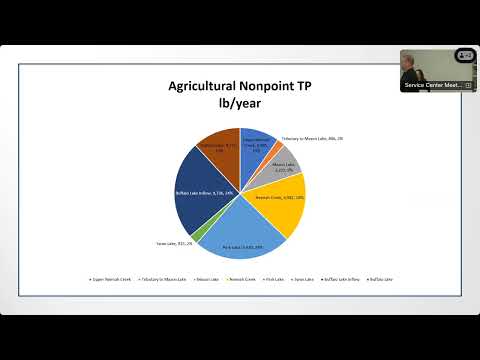
The plan will focus on two HUC12 study areas — the Buffalo Lake inflow and the Good Earth Creek watershed — selected because agriculture dominates land use in those subbasins, Speaker 1 said. Andrew (Speaker 6), the DNR contact who will review the plan before it goes to EPA for final approval, described TMDLs as the mechanism under the Clean Water Act that sets pollutant‑loading targets for impaired waters: “TMDL’s total maximum daily loads, they're part of how states and the federal government, EPA, implement the federal Clean Water Act.”
County staff said the planning work will rely on GIS and load‑estimation modeling (PLAT, EVAL, ACPF) to identify high‑priority fields and stream reaches. Matt (Speaker 8), who described the GIS workflow, said model inputs include land use, soils, crop rotations and the presence of nutrient‑management plans. Models will be used for prioritization rather than exact measurement, officials stressed.
The 9‑key plan is intended to help the county target limited implementation funds and to provide a ten‑year framework for implementation and monitoring. County staff emphasized the voluntary nature of the effort. Speaker 1 told farmers, “this is also, voluntary,” and said the goal is to use cost‑share and incentives so practices do not cause financial strain.
Officials said they will host public meetings and a formal public hearing through the county land and water conservation committee before any plan adoption. The county expects to finish the planning work within about a year and to use the plan to pursue additional implementation grants.