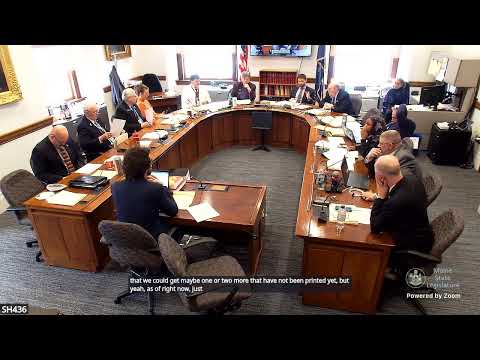
Committee hears mixed testimony on extending probation for public‑safety dispatchers
Loading...
Summary
Supporters, including state emergency communications leadership, said a longer probationary window would allow more time for training and evaluation; unions warned extending probation to a year could undermine collective bargaining and expose dispatchers to longer at‑will status.
The Joint Standing Committee on Criminal Justice and Public Safety heard testimony on LD 2090 on behalf of Representative Steve Bunker, a bill that would authorize employers to set public‑safety dispatcher probationary periods between six and 12 months and require a written probation policy disclosed at hire.
Sponsor Representative Steve Bunker told the committee that the dispatcher role has grown in complexity, involving advanced certification, multiple computer systems and life‑critical protocols, and that employers sometimes need more than six months to assess a new hire’s performance. He said his amendment preserves a six‑month minimum while allowing employers to extend probation up to 12 months and requires employers to adopt a written policy so the length is disclosed at hire.
Michael Labbe, Director of the Emergency Communications Bureau at the Department of Public Safety, told the committee that required training for public‑safety answering points (PSAPs) can include up to 18 days of out‑of‑center training plus extensive in‑center and on‑the‑job training. "With the required ... training outside of the center and you add to the regular days off, it takes almost a month of training time away from that 6 month period leaving us only 5 months in that probationary period," Labbe said, adding that in some centers six months is tight and "a year would be a better window to help us make sure everyone succeeds." Labbe said the time to feel fully comfortable can take two to three years in complex centers.
Municipal stakeholders signaled conditional support. Tanya Emery of the Maine Municipal Association said the sponsor’s amendment "strengthens our support" because it lets employers customize the probation window between six and twelve months and called a written policy a best practice.
Union testimony expressed firm opposition. William Doyle, executive director of the National Correctional Employees Union (NCEU), urged the committee to vote "ought not to pass," arguing an across‑the‑board statutory extension would undermine collective bargaining and expose dispatchers to a prolonged at‑will status. "This proposed law would extend the current probation period to 1 year, not to mention undermine collective bargaining," Doyle said, telling members probationary periods are a mandatory subject of bargaining and that mutual agreements already allow extensions in practice.
Other witnesses, including the Maine Association of Police and several municipal officials, said they were "neither for nor against" pending review of the sponsor’s amendment and asked for clarifying language on when the probationary clock begins and how existing contracts would be treated.
Committee members asked the department to prepare data for the work session, including counts of hires that failed to complete probation between months six and 12, and to propose language addressing collective bargaining concerns. No formal vote was taken; the chair closed the public hearing and the bill will be discussed at the committee’s scheduled work session.
The hearing record includes testimony both supporting a flexible 6–12 month window with written employer policy and testimony warning that a statutory default of 12 months could diminish bargaining protections; the committee requested additional data and will consider amendment language in a follow‑up work session.