Consultant briefs Sutter Butte board on Lower Feather River side‑channel project, $10M CVPIA grant funds planning
Loading...
Summary
Paul Frank of FlowWest told the Sutter Butte board that a $10 million Central Valley Project Improvement Act (CVPIA) grant plus a $250,000 Fish and Wildlife Service grant are funding planning, design and phased construction of a Lower Feather River side‑channel project aimed at restoring juvenile salmon rearing habitat; hydraulic models show minimal predicted change to the main river corridor and staff expect a first construction phase around 2028.
Paul Frank, a project engineer with FlowWest, briefed the Sutter Butte Flood Control Agency on Feb. 11 on a River Partners‑led Lower Feather River side‑channel restoration that aims to reconnect remnant floodplain channels to the mainstem Feather River to create juvenile salmon rearing habitat.
Frank said the project partners include River Partners (grantee), FlowWest (consultant), Yurok Construction Corporation (likely builder for an initial phase), Audubon Society (landowner), California Department of Fish and Wildlife (CDFW), local levee maintainers, and private landowners. He told the board the Bureau of Reclamation, through the Central Valley Project Improvement Act (CVPIA), provided $10,000,000 for planning and related work spanning roughly 2025–2028, and the Fish and Wildlife Service provided a $250,000 grant that funded a Nelson Slough feasibility study completed in 2025.
"Central Valley Project Improvement Act ... put forth near term restoration strategies ... and doing juvenile salmon habitat restoration below the confluence of the Yuba," Frank said, describing the project as part of a coordinated corridor strategy.
Frank explained the ecological need: juvenile Chinook require shallow, slow‑moving floodplain areas for rearing that are currently scarce because many remnant channels are disconnected or stagnant. The project would deepen and widen an existing borrow channel on the Audubon parcel, expand Sand Spit Slough, and create higher‑ and lower‑flow interconnected channels to improve annual flow connectivity during January–March low flows (Frank cited target flows in the range of about 3,000 to 25,000 cubic feet per second).
Frank presented hydraulic modeling for three flow scenarios (annual, 10‑year, 100‑year). He summarized the simulations: "the project would actually just barely lower the water surface in the Feather River at that annual event," noting local modeled drops of roughly 5 inches upstream and about 6 inches nearer the Sutter Bypass, while the borrow channel expected local rises ("plus 1.2 foot and plus 4 inches") and modest velocity increases in the newly connected floodplain channels (for example, "1 to 2 and a half feet per second" during an annual event). He emphasized the design objective is to avoid measurable changes to the main river corridor or to levee performance.
Board members asked about the scale and phasing. Frank said the entire footprint is roughly 5 miles and that a Phase 1 built only on the Audubon parcel could be on the order of roughly 1.5 to 3 miles, depending on landowner participation and CDFW involvement. On ecological response, Frank said monitoring will be part of construction and that juvenile cohorts are produced annually, so fish could use restored habitat quickly after construction.
Regarding maintenance, Frank said the side channels are being designed to evolve with flood processes so they should not require constant re‑excavation; River Partners and landowners would negotiate maintenance roles for site‑specific infrastructure (Frank also acknowledged existing issues such as beaver dams and blocked drains in some locations that may require attention).
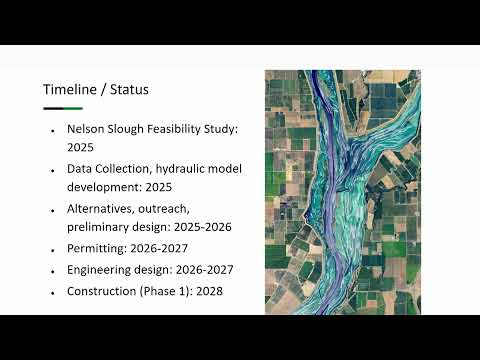
Next steps Frank listed include continued design refinement, stakeholder outreach, advancing 30–60% designs on as many parcels as possible in 2026, initiating permitting in 2026–27, and targeting a first construction phase (likely on the Audubon parcel) in about 2028.
The board did not take formal action on the presentation; staff said they will continue to coordinate with levee districts and permitting agencies as the project advances.