Get Full Government Meeting Transcripts, Videos, & Alerts Forever!
Get email alerts on the Parking Pricing topic
No spam. Unsubscribe anytime.
Participants urge parking pricing and parking-benefit districts to improve short-term access
Summary
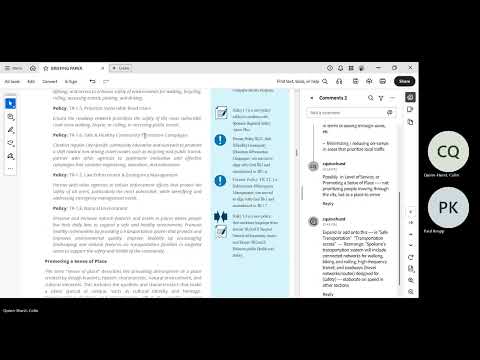
In a working session, participants recommended using pricing tools and parking-benefit districts to increase turnover, fund neighborhood reinvestment and improve access to daily-needs businesses; dynamic pricing and meter upgrades were discussed, with state law cited as a constraint for downtown congestion pricing.
Speaker 5, a meeting participant, framed the problem in practical terms: “If I'm trying to access, with a small neighborhood grocery store or something and there's unmanaged street parking out in front of it... the people who work there park, and I just need to get in and out for a quick stop and grab something.”
The group spent substantial time on Goal 9 and Goal 9.6 language that addresses parking management. Several participants recommended using price as a tool to induce turnover and preserve proximity for short visits. “Using price as a tool to induce turnover,” Speaker 8 said, arguing that dynamic or variable pricing could free up spaces for customers.
Speakers noted the city has swapped many meters to devices capable of variable pricing but that the capability has not necessarily been fully implemented. “They technically have the ability to do that, whether it's being done yet,” Speaker 7 observed. Participants discussed targeting standard occupancy levels (an 85% target was mentioned) and zone- or device-level pricing mechanisms to match demand throughout the day.
Beyond pricing, multiple participants supported the creation of parking-benefit districts—metered areas where revenue is reinvested in nearby business districts. Speaker 5 suggested using meter revenue “to both use pricing to improve that short term access to those businesses and then be able to use revenue to invest right back into that area,” citing neighborhoods such as North Monroe and East Craig as examples for reinvestment.
Concerns and caveats were raised: some worried about over-managing residential areas and the equity impacts of pricing, while others asked for clearer cross-references to the parking-management objectives in Goal 9.6. Speaker 7 recommended clarifying maximums and turnover language so the policy is not perceived as purely discouraging driving but rather as a tool to balance access and turnover.
The session closed with participants agreeing to incorporate pricing language, consider parking-benefit districts, and continue drafting in a follow-up meeting. The group did not take a formal vote on any ordinance or resolution during this session; the next procedural step is additional draft work and another convening.