
Amelia County hears plan to protect wells, repair high-school pump and search for new sources
Get AI-powered insights, summaries, and transcripts
Subscribe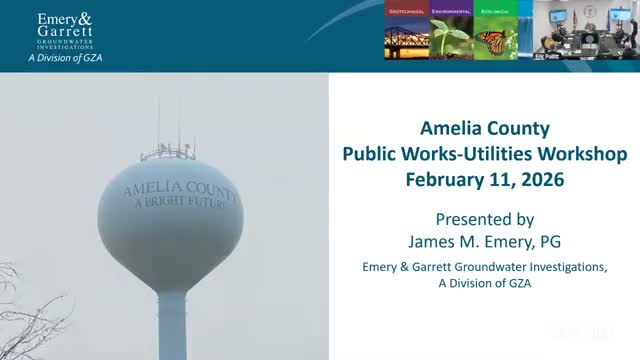
Summary
Consultants told Amelia County supervisors that two permitted wells can be brought online within a year and recommended a $300k–$350k exploratory program over two years to find additional, independent groundwater sources; the board directed staff to prioritize connecting the permitted wells and study longer-term options.
A consultant told Amelia County officials on Feb. 13 that the county's drinking-water system is currently functioning but showing the early signs of decline in some production wells and requires both short-term fixes and a multi-year search for new sources.
The presentation, led by Speaker 3, outlined three priorities: identify and protect the recharge areas that feed the county's wells, maintain an ongoing groundwater-monitoring program for levels and chemistry, and pursue exploration and permitting for one or more new high-yield wells outside existing recharge zones. Speaker 3 said the county's system was tested by a five-day pumping program that ran wells simultaneously at roughly 350 gallons per minute and that water levels recovered after testing — a positive sign — but added that since 2024 the county has observed a 10–20 foot decline in key pumping levels that warrants action.
Speaker 3 also described operational problems with two wells: one production well (S1) was taken offline because of high iron and manganese, and the high-school well is operating at reduced capacity because a pump has broken off and is stuck around 240 feet. "We're hoping that we'll be able to increase [the high-school well output] to make up for some of the lost water," Speaker 3 said. The consultant said a camera inspection and potential retrieval are options, but that drilling a replacement could also be required.
For near-term capacity, the consultant said two already-drilled, permitted wells (4A and 4B) have a combined yield of roughly 100 gallons per minute and could be connected to the system at an estimated cost of about $1.1 million; design and construction, he said, could be completed in less than 12 months if prioritized. For longer-term security, he recommended a staged exploration program: a first-year site assessment budgeted at about $130,000 and a two-year program to test and permit new sources that he estimated at roughly $300,000–$350,000.
Board members discussed trade-offs between expanding groundwater supplies (allowing incremental, demand-driven additions) and pursuing surface-water solutions, which the consultant said are capital intensive and can trigger costly environmental permitting. The consultant emphasized land-use protections in mapped capture zones, including outreach to homeowners and engagement with property owners such as a local golf course to reduce fertilizer and pesticide risks to recharge areas.
Action and next steps: the board agreed to move forward with nearer-term options. Speaker 9 noted that bringing wells 4A and 4B online was the quickest way to add capacity and could be budgeted; later in the meeting a member stated that staff (Daryl and another official) would work to get the 4A/4B connection started soon. No formal ordinance or budget appropriation was adopted at the meeting; the discussion focused on direction-setting, budgeting options and timing.
The meeting closed after a brief administrative motion to adjourn.