
McMinnville staff propose new parks SDC that would quadruple some residential charges; council divided over timing
Get AI-powered insights, summaries, and transcripts
Subscribe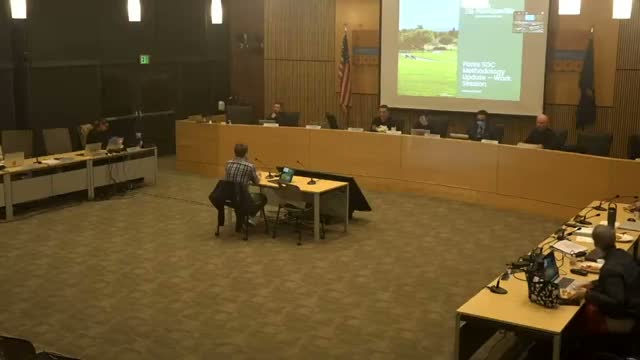
Summary
Public Works Director Jeff Hunsicker presented a consultant-led parks SDC methodology driven by the 2024 PROS Plan that would add commercial/industrial charges and raise the average residential park SDC to about $12,500 from the current $3,200. Councilors asked for more analysis on affordability and whether affordable housing should receive discounts.
Public Works Director Jeff Hunsicker told the McMinnville City Council on Feb. 10 that the city needs a new parks system development charge (SDC) methodology to align with the 2024 Parks, Recreation and Open Space (PROS) Plan and to ensure growth pays its share of capacity expansion. The current SDC methodology dates to 1998, Hunsicker said, and does not charge commercial or industrial development.
Hunsicker said the methodology uses an "equivalent population" approach: the plan assumes nearly 13,000 new residents between about 2020 and 2041, and adds employment growth by treating one employee as equal to one-third of a full-time resident, producing roughly 15,000 equivalent new residents for the 20-year horizon. The city's adopted service standard is 8.5 park acres per 1,000 equivalent population; staff used that standard to derive capital needs in the CIP.
The presentation broke the SDC-eligible cost into major drivers: roughly $33 million for neighborhood parks, $26 million for a community park, and about $20 million for proposed greenway development. Using a consultant estimate of about $600,000 to develop one acre of park, staff said the total investment to accommodate projected growth was about $81.9 million; after assumed offsets (including historical grant/donation offsets) the net cost per equivalent person was presented as $4,936.73.
Under the consultant's model, residential SDCs would move to a tiered system by house size. Hunsicker cited an "average house" SDC near $12,500; the city's existing flat park SDC was described in the presentation as roughly $3,200 per unit. He also noted that because McMinnville indexes SDCs to a construction-cost index (which fell 3.8% last year), some SDC figures are scheduled to adjust in July under current rules.
Councilors asked detailed questions about assumptions and impacts. Councilor Tokalski asked whether employees included in the employment forecast could also be double-counted as new residents; Hunsicker said he would review the methodology and report back. Councilors pressed the consultant's choice to count each employee as one-third of a resident, with one councilor calling that ratio "a really high percentage" given typical work schedules and off-days. Others argued that employees who come into McMinnville for weekend sports or lunchtime use do increase park demand.
Members debated whether affordable housing should be exempted from parks SDCs. Hunsicker said the city's code currently waives only sewer and transportation SDCs for certain affordable housing, not parks SDCs. Several councilors asked staff to return with options for discounts, caps, or defined annual backfill amounts if council chose to reduce or waive charges for affordable projects.
Several councilors voiced concern about the scale of the proposed residential increase, saying the combination of lot prices and higher SDCs could affect housing affordability. Others urged that the city is underfunding parks by relying on a 1998-era 50% recovery model and should move toward full recovery to deliver the PROS Plan projects. Hunsicker said staff can bring a resolution and ordinance when the council is ready, but several members asked for more analysis on economic impacts before formal adoption.
Next steps: staff said they could bring the methodology forward for a formal resolution and ordinance; several councilors requested additional detail on employee/resident counting, the specific list of SDC-eligible CIP projects, and the fiscal effect of any affordable-housing discounts before the council votes.