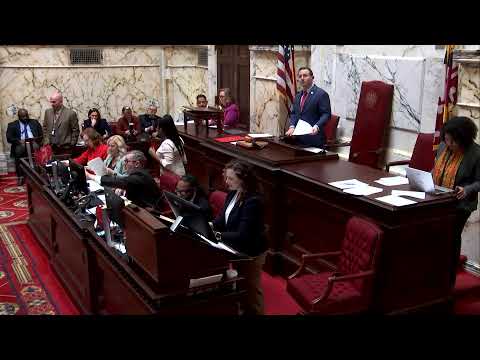
Maryland Senate advances broad package of bills on third reading; transportation bond limit, tax credits and social supports highlighted
Loading...
Summary
The Senate confirmed committee reports and moved many bills to final passage on Thursday, including a $1,000 refundable tax credit for parents of stillborn children, a $1 billion increase in MTAA debt capacity, and dozens of other bills declared passed on third reading; roll-call tallies were recorded for several votes.
The Maryland Senate used Thursday’s session to advance a large slate of legislative items from committee reports into third reading and to declare final passage on multiple bills across several calendars.
Transportation and bonding: Floor debate on Senate Bill 188 explained that the Maryland Transportation Authority’s bond capacity would increase from $4 billion to $5 billion to support capital preservation and work such as the Francis Scott Key Bridge reconstruction. The floor acknowledged the change could be used for a range of MTAA capital needs; the favorable committee report was adopted and SB 188 was ordered printed for third reading.
Tax and economic policy: Aside from SB 247 (biotech grant conversion), the Senate adopted committee reports on tax-related measures including SB 25 (cybersecurity technology and service tax credit alterations) and SB 58 (authorization for local governments to offer property tax credits to encourage conversion of idle service stations). On SB 58, a senator questioned whether state funds would be used; the chair said the provision that would have reimbursed counties at 50% was removed and the program is entirely a local option with no state money involved.
Family supports and health: The Senate advanced SB 356, which would establish a refundable state income tax credit of $1,000 for a parent of a stillborn child (effective July 1, 2026; applies to tax year 2027 and beyond); committee amendments were adopted and the bill was ordered printed for third reading.
Third-reading roll calls and final passage: The clerk conducted roll calls across the third-reading calendar and the Senate declared numerous bills passed. Reported final tallies in the transcript include counts such as: SB 14 (constitutional majority declared passed), SB 21 (44 affirmative), SB 22 (44 affirmative), SB 43 (44 affirmative), SB 65 (44 affirmative), SB 70 (44 affirmative), SB 83 (44 affirmative), SB 128 (44 affirmative), SB 133 (44 affirmative), SB 134 (44 affirmative), SB 139 (44 affirmative), SB 141 (44 affirmative), SB 161 (44 affirmative), SB 164 (43 affirmative reported), SB 167 (44 affirmative), SB 169 (32 affirmative), SB 186 (43 affirmative), SB 199 (43 affirmative), SB 205 (43 affirmative), SB 207 (43 affirmative), SB 226 (44 affirmative), SB 228 (44 affirmative), SB 248 (44 affirmative), SB 260 (44 affirmative), SB 32 (44 affirmative), SB 88 (44 affirmative), SB 96 (44 affirmative), SB 192 (44 affirmative), SB 216 (44 affirmative), SB 244 (44 affirmative). The transcript pauses briefly for timing and arrival of guests before continuing.
What happened next: Many of the listed bills were declared passed after roll calls; final enactment will depend on subsequent processing, signatures where required, and any cross-chamber actions. Several bills were described as emergency measures or departmental bills; Fiscal notes and implementation details remain in committee or fiscal documents referenced during the session.
Provenance: This article summarizes committee reports, floor questions, sponsor remarks, and roll-call statements recorded during the session.