Hemet outlines plan to add stations and squads as calls surge, estimates $20 million per new station
Loading...
Summary
City staff recommended siting three new fire stations to reduce long response times in fast-growing parts of Hemet, noting the city is near 20,000 annual calls and that construction and staffing for a two-bay station could cost about $20 million and $2.5 million a year respectively.
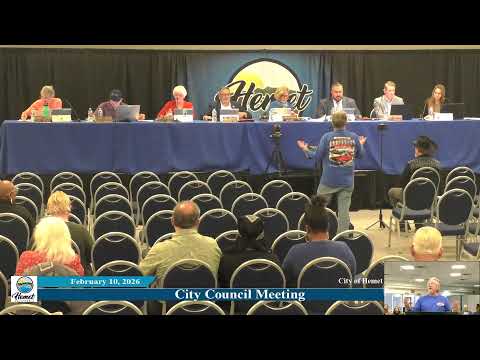
Hemet officials on Feb. 10 presented a multi-year plan to relocate one existing fire station and add three new stations to address rising call volumes and prolonged response times in outlying areas.
Chief Webb told the City Council the department’s goal is “6 minutes and 30 seconds and 90% of the calls,” a target the department has not met since 2014. Webb said Hemet’s system averaged roughly 7 minutes, 34 seconds before the recent deployment of a squad unit, and that adding Squad 4 later in the year shaved about 24 seconds off systemwide response times.
The presentation identified two priority trouble spots: the 4 Seasons area, which Webb said has an average response time of about 10 minutes, 12 seconds, and the McSweeney area. Webb said those delays stem from distance to existing stations and frequent unavailability of the busiest units. He also presented concurrency data—instances when a district’s primary unit is already committed—reporting about 2,049 concurrent calls in District 1 and nearly 3,000 in District 3 for 2024.
To address the problems, staff recommended adding Station 6 near McSweeney to reduce wildland and brush-fire risk, Station 7 west of the current Station 3 to lower travel times into 4 Seasons, and Station 8 on the city’s southwest side to serve forecasted growth. Webb said the city has identified potential city-owned parcels for some sites (including a roughly 1.6-acre lot at Devonshire and Warren and an elongated parcel at 2100 West Menlo) but that each parcel needs further environmental and footprint review.
On costs, Webb estimated modern two-bay stations at about $1,600 per square foot based on a neighboring jurisdiction’s recent project. He said a roughly 10,000-square-foot, two-bay station carries a building price tag of about $16 million plus land and utilities, “so we’re ballparking it at about $20,000,000.” Webb also estimated staffing for a staffed two-bay station at about $2,500,000 per year under the department’s current model.
City manager staff briefed council on near-term operational steps. They said adding mobile squad units has produced measurable improvements and remains a less expensive, faster-deployable relief option while new stations are designed and built. The manager’s office proposed a financial work program—an approximately $5,000 revenue-production study and a $40,000–$50,000 feasibility analysis—to evaluate bonding and other funding paths such as general obligation bonds, state appropriations or federal earmarks.
Council members asked about developer fees and community facilities districts (CFDs) as funding sources; staff confirmed a $3.7 million reserve from McSweeney developer impact fees is earmarked for a McSweeney station. The presentation closed with an agreement from council to have staff return with more detailed cost, funding and feasibility analyses and to involve Council Member Clark in the follow-up work.
The department and city stressed these are preliminary recommendations, not final siting decisions. Staff said building a permanent station is typically a multi-year effort—about two and a half to three years from ground-breaking on a favorable schedule—and that designs, permitting and funding choices will determine the final sequence.
If council directs the next steps, staff said it would present more detailed site studies, cost estimates and funding scenarios for the council to consider before any project is approved.