
St. Louis County approves $187,500 in Tom Rookavina scholarships, narrowly votes to set aside remaining mineral royalties for endowment
Get AI-powered insights, summaries, and transcripts
Subscribe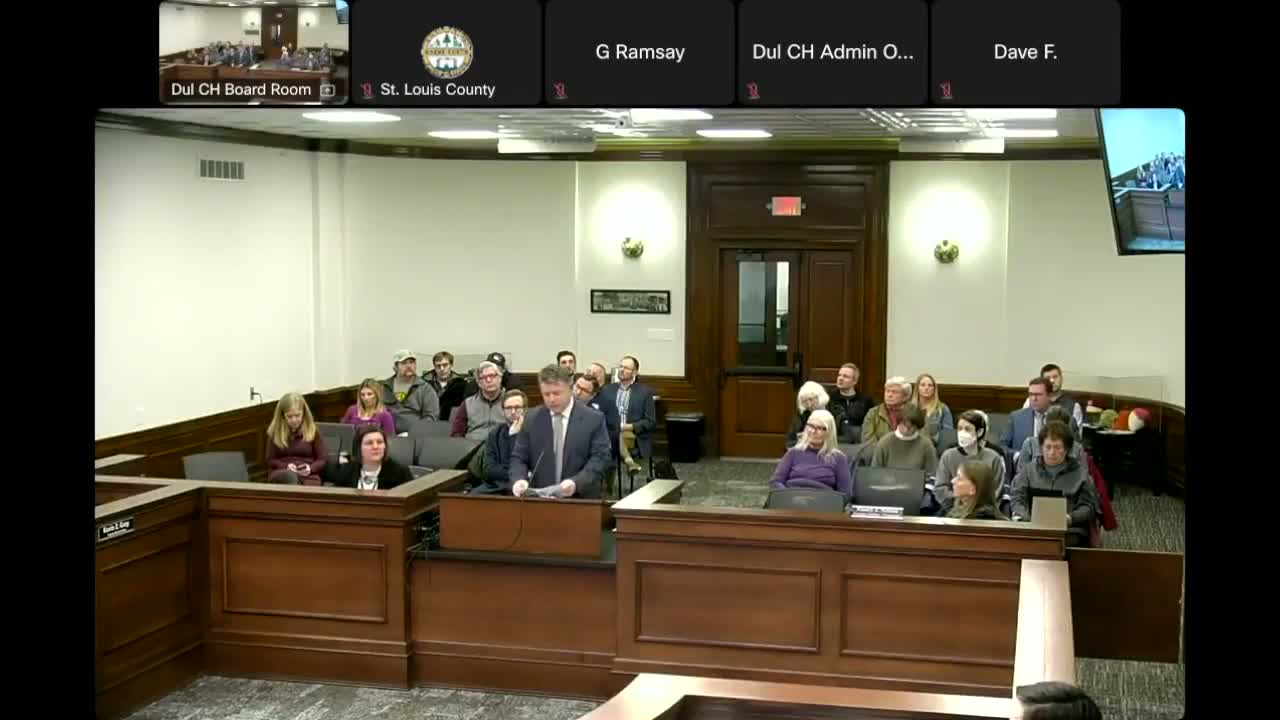
Summary
The County Board approved $187,500 in mineral-royalty scholarships for 2026 and voted 5–2 to direct any remaining mineral royalty dollars into a corpus-builder account for a future endowment, following hours of testimony from college and trades representatives and a contentious debate among commissioners.
The St. Louis County Board on Monday approved $187,500 to fund mineral-royalty scholarships for 2026 and separately voted to direct any remaining mineral royalty funds into a restricted corpus-builder account that could seed a future endowment.
Deputy County Administrator Jim Gottschall framed the program’s history and purpose, telling the board the request before them was "to approve disbursement of $187,500 to fund mineral royalty scholarships in 2026." He noted the scholarship program has distributed more than $1.2 million since 2017 and emphasized its ties to the county’s mining legacy.
Representatives from Minnesota North College, Lake Superior College and the Duluth Building and Construction Trades described how the money is used. Trent Janesich of Minnesota North College said the scholarships often cover technical-training programs and that the college typically gives out roughly 77–83 awards annually. "These scholarships are like gold for us at Minnesota North College," he said. Jack Carlson, president of the Duluth Building and Construction Trades Council, told commissioners the awards help apprentices afford essentials such as work boots, tools and transportation: "These are our friends. These are our families that are receiving these funds."
Commissioners pressed presenters for details about overlap with the state’s North Star Promise program. College speakers explained North Star Promise is a "last dollar in" program that covers tuition and fees only, so many nontraditional costs (housing, childcare, transportation) remain gaps county scholarships can fill.
The board first voted to approve the allocations to the listed organizations (the line-item disbursements of $37,500 each) by roll call. Clerk Chapman recorded a roll-call vote in which commissioners present voted in favor for the allocation portion.
The meeting then turned to a longstanding and intensifying debate: whether to continue allocating scholarship dollars annually from mineral royalties or to begin accumulating unspent mineral royalties into a corpus-builder (endowment) account that could guarantee funding in perpetuity. Commissioner Nelson argued passionately for a corpus, saying an endowment would "ensure that these dollars are going to be there for these valuable investments that we are making in people." Opponents and cautious commissioners raised concerns about locking funds away amid tight budgets and noted statutory and timing limits on mineral-royalty revenue.
A procedural motion to split the question — separating the annual allocations from the 'resolved further' corpus direction — failed on a preliminary vote. Later, the board conducted a roll-call vote on the primary allocations and then a separate roll-call vote on directing remaining mineral-royalty funds to a corpus-builder account. The latter passed 5–2; administration told the board the county’s current restricted corpus balance is approximately $2.1 million pending final 2025 closeout by the auditor.
Board members said they will continue budget work and oversight as the county monitors mineral-royalty receipts and the corpus balance. Administrators noted that directing "remaining" funds to the corpus does not automatically spend budgeted scholarship dollars; it affirms that any uncommitted mineral-royalty dollars at year-end will be added to the restricted corpus.
The board also asked staff to provide additional reporting on scholarship recipients and the interaction between local scholarships and the North Star Promise so commissioners have clearer data for future decisions.
The vote on the corpus measure leaves both a near-term commitment to scholarships and a formal path to build an endowment — a compromise some commissioners described as both practical and provisional.
What's next: County staff will finalize 2025 fiscal closeouts to determine the exact amount available, and the board's finance/budget conversations this year will consider ongoing policy on the corpus and annual scholarship allocations.