
Arlington School District projects enrollment decline and $3.5M–$4.5M in possible budget reductions
Get AI-powered insights, summaries, and transcripts
Subscribe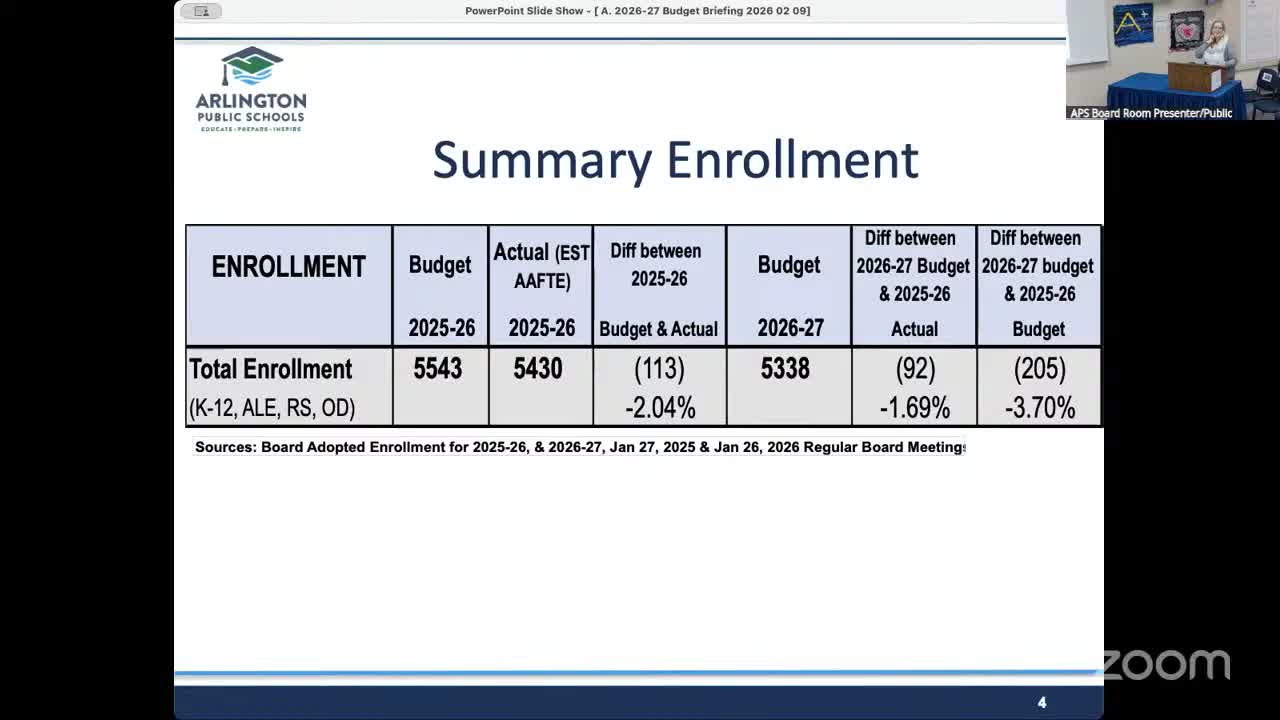
Summary
District finance director told the board that enrollment projections and state assumptions mean the district faces roughly $900,000 less revenue this year and an estimated $2.7 million next year, prompting a plan to reduce expenditures by about $3.5M–$4.5M if attrition alone does not close the gap.
Gina Zukenhorst, the district’s executive director of financial services, said the Arlington School District’s enrollment and state funding assumptions point to a multiyear budgeting squeeze.
Zukenhorst told the board the district’s current-year projected average enrollment is about 5,430 full-time-equivalent students, down from the prior budget’s 5,543, and that the 2026–27 projection is 5,338. “That is actually a 113 less student FTE than our, initial budget plan,” she said, and projected revenue shortfalls include roughly $900,000 less this year and about $2.7 million less next year.
Why it matters: enrollment drives state apportionment funding, and lower student counts reduce predictable revenue. Zukenhorst warned that, combined with updated inflation assumptions (an implicit price deflator of about 2.7 percent), the district will likely need to align expenditures to revenue by reducing spending in the range of $3.5 million to $4.5 million.
Board members pressed for causes and options. A director asked where roughly 205 students in the budget-to-budget comparison had gone. Zukenhorst noted declining birth rates, increased participation in running start programs and early graduations, and a wider array of educational choices (private schools, homeschool) as possible contributors, adding that specific movement is still being examined. “All of those are speculative,” she said.
Zukenhorst described planning steps and near-term deadlines the board should expect: retirement notices are helpful by Feb. 15 for planning purposes, a budget advisory task force will meet on Feb. 17, the legislature’s short session is expected to conclude March 12 (which could change revenue assumptions), and statutory deadlines include posting a budget draft to the website by July 10 and adopting a final budget by Aug. 31.
She also highlighted a recent change in tax policy that could affect costs: a statewide rule now requires sales tax on certain services, and she said school districts’ exclusion was not explicitly preserved. That change particularly affects contracted special-education services. Zukenhorst said advocacy is underway and estimated potential legislative relief could reduce district costs by about $250,000 if clarified in the legislature.
What’s next: Zukenhorst said cabinet and district leaders will refine classroom- and staffing-level projections in coming weeks and bring a resolution to the board in March–April signaling any reduced-education program needed for 2026–27. The budget advisory task force will review the same materials on Feb. 17, and staff will return with more detailed expenditure scenarios and staffing implications later this spring.