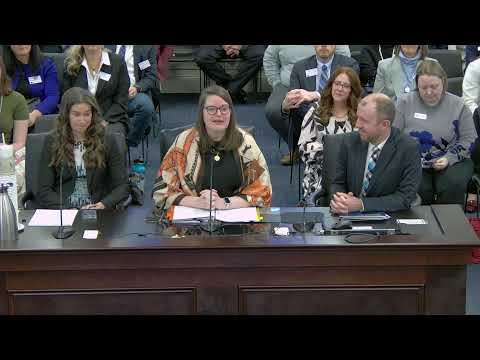
Committee advances wide-ranging childcare reform bill, orders All Stars audit
Loading...
Summary
The House Families and Children Committee approved House Bill 6, a 43-page childcare reform package that creates a two-year pilot for military off-base childcare, authorizes limited 'microcenters,' and moves to privatize the Employee Childcare Assistance Program; a companion resolution directs an audit of the All Stars quality-rating program.
State Representative Samara Heffern and stakeholders won committee approval Thursday for a 43-page package of childcare reforms when the House Standing Committee on Families and Children voted to advance House Bill 6 by a 12–0–1 margin.
"Members of the Family and Children Committee, this has been a long time coming," State Representative Samara Heffern said as she introduced the bill, which she described as the product of a collaborative of more than 40 stakeholders focused on affordability, quality and access.
The bill includes a two-year pilot developed with the Department of Defense to allow off-base childcare for military families at Fort Campbell and Fort Knox, an emergency clause to permit a July 1, 2026, start for that pilot, and several program reforms aimed at both center- and home-based care. It also authorizes a new regulated provider type called "microcenters," initially limited to 10 statewide with no more than two per county. Charles Ault, vice president of policy and research at the Kentucky Chamber of Commerce, described microcenters as "in between those 2 worlds" of traditional centers and family child care homes, intended to fill gaps such as third-shift or drop-in care.
Heffern said the measure also restructures the Employee Childcare Assistance Program (ECAP) and calls for privatization of ECAP before expanding eligibility. "If you're an employer and you wanna say let's say $400 a month to your employee, the state will match that dollar for dollar as long as they make less than the state median income, which I believe is about $65,000," she said, outlining the current matching framework the bill seeks to stabilize before broader expansion.
Mandy Marler of Baldwin Consulting, representing child care stakeholder interests, emphasized that HB 6 seeks to modernize Kentucky’s All Stars quality-rating program and related processes while preserving federal compliance: "The All Stars program is our quality rating system in Kentucky," she said, noting the program’s ties to federal Child Care and Development Block Grant (CCDBG) requirements.
Committee members praised the collaborative approach and thanked bill authors and stakeholders. After discussion and a roll call, the committee voted to pass HB 6 as amended, and later approved a title amendment.
The committee also unanimously passed House Joint Resolution 50, a companion measure directing the Auditor’s Office to study administrative regulations, statutes and agency processes affecting the opening and operation of licensed and certified childcare services and the All Stars program; the resolution passed 13–0. Committee leaders said the study would identify regulatory or statutory barriers and report back to the legislature.
The committee scheduled its next meeting for Thursday, February 19, in the annex room of the Statehouse. The bill will proceed next according to the House’s scheduling rules.