
Solar contractor urges passage of H.716, says behind‑the‑meter charge and shrinking net‑metering value are pricing out Vermonters
Get AI-powered insights, summaries, and transcripts
Subscribe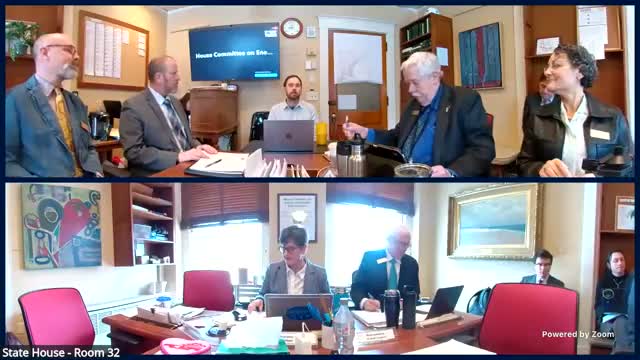
Summary
Jared Cobb of Catamount Solar told the House Energy committee that sudden loss of a federal tax credit, $62 million in state funding changes and negative net‑metering adjusters have pushed payback periods from about 7–8 years to 12–13 years, and he urged lawmakers to eliminate the 'behind‑the‑meter' deduction in H.716.
Jared Cobb, general manager of Catamount Solar, told the House Energy & Digital Infrastructure committee on Feb. 12 that H.716 should be passed to stop what he described as diminishing compensation for rooftop solar and the administrative burden created by production meters. Cobb said his Randolph‑based, worker‑owned firm has 25 employees (13 co‑owners) and donates 5% of net profits to community organizations.
Cobb said the industry faces three main headwinds: the sudden loss of a federal residential tax credit, the removal of roughly $62,000,000 in state solar funds, and higher material costs driven by tariffs. Those changes, he said, have lengthened payback periods for typical residential systems from seven or eight years to 12 or 13 years, making sales to middle‑income households difficult. "We had a short five months to adjust for a huge disruption in the industry," Cobb said.
Using a legislative handout, Cobb walked committee members through how net‑metering adjustments have changed since 2020. He said net‑metering adders that were roughly +2¢ per kilowatt‑hour in 2020 have moved to about –4¢ per kilowatt‑hour in 2026, and that shift requires roughly a 44% larger solar array to offset a $2,000 annual electric bill. "Rather than a $33,000 system, in 2026 you're looking at a $48,000 system," Cobb said, adding that the loss of the tax credit increased the customer‑facing cost by about $15,000 on his example system.
Cobb urged the committee to eliminate the so‑called "behind‑the‑meter" deduction that reduces compensation for power produced and consumed on a customer’s property. He described the production meter used to measure on‑site solar production as both a cost and a source of complexity: "The only purpose of that production meter is so that the utility can keep track of it and then deduct value from the customer," he said. He told members that removing that deduction would remove the need for many production meters and simplify billing to a single bidirectional meter.
Committee members questioned technical details. Cobb explained that Vermont utilities commonly use a separate production meter (in addition to a bidirectional utility meter) to record solar produced on site; he said municipal utility practices vary. On battery integration, Cobb said his firm installed roughly 200 systems and about 300 batteries last year (about 1.5 batteries per system). He warned that production meters complicate battery installations and cited a Stowe Electric customer whose system remained offline while the utility worked to determine proper metering for an integrated inverter/battery unit.
Cobb also cited a summer study of the ISO‑New England grid, saying behind‑the‑meter solar and batteries reduced peak demand and preserved system value, estimating about $19,000,000 in avoided costs on one hot summer day. He argued that this system‑level value supports policies that encourage distributed generation.
On financing, Cobb said local credit‑union loan rates his firm uses hover around 7%, and that while early adopters benefited from lower rates years ago, "most of our customers are cash customers" now because current economics make financed projects less attractive. He added that production‑meter installation itself is not the bulk of the cost (he and committee members discussed figures in the hundreds to a few thousand dollars), but the combined effect of the meter plus the negative adjuster materially reduces customer value—he estimated roughly $5,000 in lost value for his example system.
Cobb closed by saying Vermont policymakers face choices about whether to continue allowing net‑metering compensation to erode. "If we want distributed generation in Vermont, we need to help the solar industry," he said. The committee took technical questions but did not take a vote on H.716 during the session.
The committee will receive further testimony and staff analysis as members consider whether to move a draft forward before crossover.