Senate panel advances CHFA-backed home-loan program for first responders
Loading...
Summary
The committee advanced SB53 to let the Colorado Housing and Finance Authority offer a CHFA-backed 'Colorado Champions' home-loan program for law enforcement and other first responders, removing statutory income limits for those professions and using CHFA loan tools for down-payment assistance.
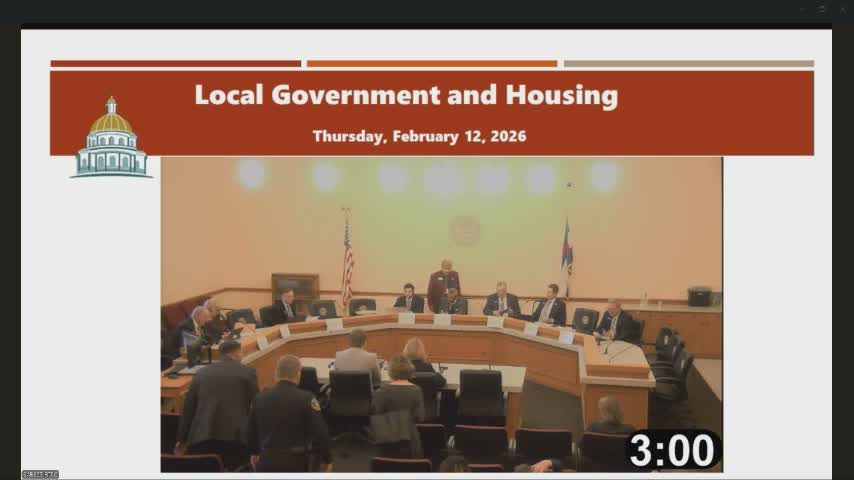
The Senate Local Government and Housing Committee on Thursday voted 6–1 to advance SB53, a bill that authorizes the Colorado Housing and Finance Authority to offer a Colorado Champions Home Loan program for law enforcement officers and first responders.
Sponsor Senator Kirk Meyer said the program is modeled on CHFA’s existing products and is designed to help first responders afford homes in the communities they serve. The measure amends CHFA’s enabling statute to permit loans to qualifying first responders without the statutory income limits that apply to some CHFA products and allows CHFA to pair first mortgages with down-payment assistance options such as a 3% grant or a silent second (up to 4% of the loan amount) to reduce private mortgage insurance barriers.
CHFA business development manager Paige Omohundro told the committee the agency supports SB53 and will design the program within existing investor, insurer and rating-agency constraints; she said CHFA does not expect significant operational or financial impacts from the statutory change. CHFA representatives explained that program mechanics — including how 'family' is defined for eligibility, down-payment assistance parameters, loan amounts and other underwriting rules — will be determined through CHFA processes and conform to annual conforming-loan limits (testimony cited a conforming limit of $806,500 for 2026).
Public-safety witnesses backed the proposal. Captain Brandon Natlitsch of the Colorado State Patrol and Larimer County Sheriff John Phelan testified that high housing costs in mountain corridors and other areas make recruitment and retention difficult and that some deputies now live out of state because of housing affordability concerns.
Committee members probed means testing and targeting, asking whether high-earning officers could access the benefit; CHFA responded that although the statute would not impose an income limit for first responders, the agency’s program caps and underwriting rules (including annual conforming-loan limits) will constrain loan size and program use. Sponsors also moved and the committee adopted amendment L001 to clarify the definition of peace officer (the amendment did not yet include 9-1-1 dispatchers; sponsors said they intend to address that in a subsequent amendment).
After discussion about program design and targeting, the committee voted to advance SB53 as amended to the Committee of the Whole with a favorable recommendation, 6–1. Committee members said they intend to continue oversight of CHFA’s implementation details as the program is developed.