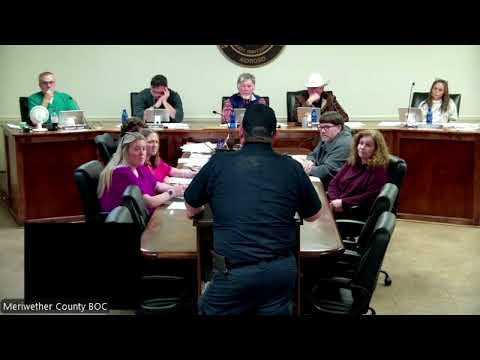
Meriwether County leaders hear EMS, 911 reports showing long transports and staffing gaps
Get AI-powered insights, summaries, and transcripts
SubscribeSummary
Fire and EMS and the 9-1-1 director reported longer-than-average transport and offload times, rising EMS revenue and persistent staffing shortages; commissioners discussed telemedicine pilots and recruitment constraints.
Fire Chief and EMS Director Danny Stevens told the Meriwether County Board of Commissioners on Feb. 9 that the county’s emergency medical services handled 397 calls in January and recorded 12.8 calls per day that month. He said EMS calls comprised about 82.3% of the department’s responses in 2025, while fire calls made up roughly 3.37%.
Stevens outlined response metrics used by the department: average turnout around 2.4 minutes for EMS, a response time of about 11.8 minutes, and an average time on scene of 17.8 minutes. He said transports from scene to hospital averaged about 29.5 minutes, a round trip that typically removes an ambulance from county service for roughly 50 minutes to an hour when offload delays are included. The department’s 90th-percentile patient offload time was cited as about 39 minutes, a factor Stevens linked to regional emergency department crowding.
Stevens told the board the department’s revenue increased to about $1,400,000 in 2025, up from roughly $800,000 the prior year after changes to billing processes and a new billing company. He described ongoing recruitment and training work: seven recruits entered the fire crew class, the department advertised multiple openings and reported approximately 1,084 open shifts in 2025 (about 19.8% of total annual shifts). Stevens said the department is replacing radios, ordering two tenders with fabrication expected in spring, and seeking an additional ambulance remount amid supply lead times.
Brennan Jones, the county’s 911 and EMA director, reported that the county’s call center handled 13,703 CAD-documented emergency responses and 27,443 administrative/nonemergency calls in 2025 for a total of 41,749 calls. Jones said the center averaged a 3.2-second answer time on emergency lines, typical dispatch within 45 seconds for serious calls, and an average call-handling time near two minutes. He noted eight current dispatcher vacancies and said training capacity limits the center to training four trainees at a time because each trainee requires a dedicated trainer and on-the-job supervision.
Commissioners asked about telemedicine in ambulances as a way to reduce unnecessary transports. Stevens said telemedicine programs are still new in Georgia, the county is monitoring pilot programs elsewhere, and that telemedicine could allow clinicians to triage some patients to primary care rather than transport to an emergency department. Jones said the county has implemented a new radio system and used roughly $140,000 in storm-related grant money toward radio improvements, while acknowledging some integration issues remain with the legacy system.
The board did not take a policy vote on EMS staffing or telemedicine but asked staff to continue pursuing recruitment and to bring possible telemedicine presentations from vendors to a future meeting. The county’s next procedural step on staffing and technology is a work session and follow-up discussion with department leadership.