Get Full Government Meeting Transcripts, Videos, & Alerts Forever!
Get email alerts on the Tif Policy Process topic
No spam. Unsubscribe anytime.
Norman council seeks formal TIF application framework, more citizen input and stronger economic review
Summary
Staff presented a proposed framework to standardize TIF district applications, including a uniform application, possible citizen TIF committee, a third-party economic and risk analysis, and options for application fees and supermajority voting rules. Staff will draft ordinance language and return for review.
City staff outlined steps to create a more uniform process for establishing tax increment financing (TIF) districts and asked council for guidance on citizen input, required analyses and voting rules.
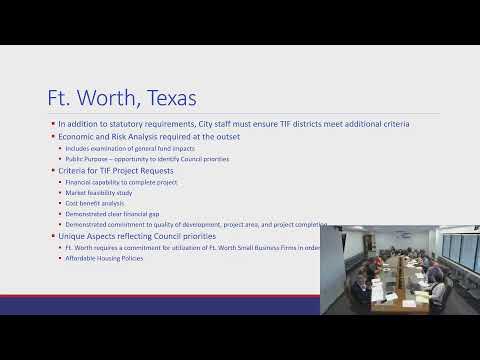
"Just because something legally qualifies for a TIF doesn't mean it's necessarily right for the community," said a staff member (Speaker 5) while presenting policy examples from Fort Worth and Olathe that add public-purpose criteria and analysis requirements on top of state statutory procedures.
Staff recommended a structured application and review process that could include an application fee to cover independent economic and market feasibility studies, a payback or refund of that fee if a project is approved, and the procurement of third-party analysis to evaluate general-fund impacts and developer pro forma assumptions. Staff referenced past uses of Department of Commerce reports and private firms (Hunden Partners) as examples of layers of analysis used in prior TIF reviews.
Council discussed safeguards: deductions to address sales-tax 'cannibalization' from businesses relocating into a TIF area, pay-as-you-go financing as a protection for the city, minimum developer contributions or performance bonds, and design/architectural standards to protect community character. The city attorney and staff cautioned that requiring higher council vote thresholds for ordinary ordinances may conflict with the charter and could require a charter amendment.
Staff estimated a typical 6-to-9-month process to draft an ordinance and complete local-development-act review for a TIF, but said timing varies by project; they committed to bring back draft policy language and to schedule additional study sessions. No binding ordinance or vote was taken at the meeting.