
Administration says EPA has eliminated 2009 "endangerment finding" and related vehicle greenhouse‑gas standards
Get AI-powered insights, summaries, and transcripts
Subscribe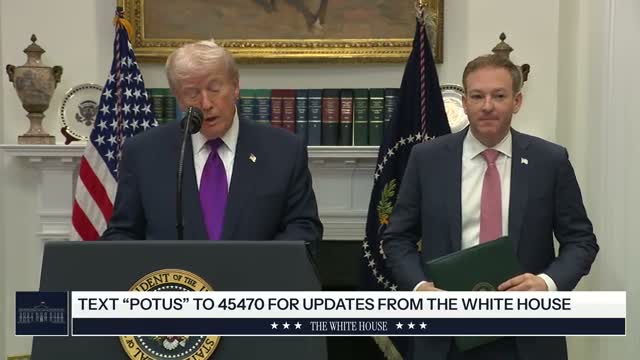
Summary
At a press event, the president and EPA Administrator Lee Zeldin announced the termination of the 2009 EPA "endangerment finding" and associated greenhouse‑gas vehicle standards, calling it the largest deregulation in U.S. history; the administration framed the move as saving consumers and restoring regulatory limits, while reporters raised questions about public‑health and legal implications.
The president and EPA Administrator Lee Zeldin announced that the Environmental Protection Agency has eliminated the 2009 "endangerment finding" that underpinned federal greenhouse‑gas regulation of motor vehicles.
At a news event, the president said the agency action "officially terminating the so called endangerment finding" will reduce regulatory costs and lower vehicle prices. "This action will eliminate over $1,300,000,000,000 of regulatory cost and help bring car prices tumbling down dramatically," the president said. Zeldin called the decision "the single largest act of deregulation in the history of The United States" and said the rule is "now eliminated." (Lee Zeldin is identified in the transcript as EPA administrator.)
Why it matters: The 2009 endangerment finding is the legal basis EPA has used to regulate greenhouse gases under the Clean Air Act. Zeldin told reporters the administration reexamined the agency's authority in light of recent Supreme Court decisions named in the transcript and concluded that rulemaking should follow "the plain language of the law" and congressional action if stronger authority is desired.
What the administration claims it will do: Both speakers framed the repeal as restoring consumer choice and cutting costs. The president said the action will terminate greenhouse‑gas emission standards imposed on vehicle models and engines between 2012 and 2027 and repeated claims about average vehicle price reductions. Zeldin said manufacturers "will no longer be burdened by measuring, compiling, or reporting greenhouse gas emissions for vehicles and engines" and described the end of what he called a "forced transition to electric vehicles." The administration stated the elimination has been signed and delivered.
Numbers and precision: The transcript contains several large numerical claims from the podium: a $1.3 trillion figure for regulatory savings and multiple per‑vehicle savings figures (the president referred to an "average cost of a new vehicle" falling by "close to $3,000;" Zeldin repeated a per‑vehicle savings figure expressed in the transcript as "over 2,400 vehicle, $2,400 for a new vehicle," which appears inconsistent and garbled in places). The administration also cited large investment and job figures, including a claim of "over $100,000,000,000" in near‑term foreign automaker investment. These figures are reported here as stated on the record; the transcript shows inconsistent per‑vehicle amounts and one per‑vehicle figure that appears mis‑transcribed and should be treated as unclear.
Legal context: In the remarks, Zeldin cited the Clean Air Act as the statute governing EPA authority and referenced recent Supreme Court precedent (named in the transcript as "Loper Bridal Enterprises and West Virginia versus EPA"). The correct case names in recent Supreme Court jurisprudence include West Virginia v. EPA and Loper Bright Enterprises (the transcript contains a mis‑rendering of the Loper case name). The administration said that, in light of those precedents, EPA is recalibrating its rulemaking to follow congressional authorization.
Responses and questions: Reporters asked whether the rollback will harm public health and the environment; the president rejected that framing, calling the previous rule a "scam" and saying it "has nothing to do with public health" (transcript). Reporters also pressed on related topics, including wind turbines, farm‑equipment standards and the legal and practical implications of revoking the endangerment finding.
What was not specified: The transcript does not include a schedule for how EPA will implement the termination, whether the agency published a notice of rulemaking or a final rule text on the Federal Register, or whether affected regulations will be subject to litigation; those steps were not part of the remarks on the record. The transcript likewise does not include independent evidence supporting the administration's claimed savings calculations.
Next steps: On the record the administration said the elimination is in effect and "signed, sealed, and delivered," but the transcript does not provide further procedural details such as Federal Register citations, effective dates, or forthcoming regulatory texts. Absent those details, interested parties will need to consult EPA rulemaking notices and agency publications for the formal administrative record.