Guam senators press Port Authority on aging cranes, tariff petition and modernization plans
Get AI-powered insights, summaries, and transcripts
SubscribeSummary
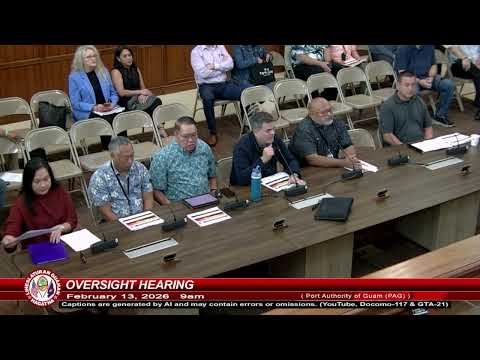
At a Feb. 13 oversight hearing, Port Authority of Guam officials defended recent modernization work and federal grant-seeking for three 42‑year‑old gantry cranes, while detailing performance metrics, federal grants and a tariff petition pending before the Public Utilities Commission. Senators pressed management on funding timelines, customs coordination and workforce readiness.
The Guam Legislature’s oversight committee questioned Port Authority of Guam leaders on Feb. 13 about the port’s readiness, finances and a multiyear push to replace decades‑old gantry cranes central to cargo throughput.
Port management told senators the port handles “over 90% of all goods coming into the island,” and outlined a multi‑year master plan that it said moved the agency from stabilization and recovery into a 2026 phase of institutionalizing reforms and executing capital projects. “When the port is efficient, Guam’s cost of living goes down,” the committee chair said in opening remarks.
General management said the port submitted a third MARAD grant application for replacing three 42‑year‑old ship‑to‑shore gantry cranes, and that MARAD recently waived a Buy‑American restriction for STS cranes serving Pacific ports. The port believes that waiver removes a major barrier to award; officials said they expect a decision imminently. “If Merit doesn’t approve, we’re going to have to consider how we raise the capital,” the general manager said.
Management emphasized the urgency: PUC assessments put the cranes’ functional lifespans into the 2028–2032 range, and port officials warned that a crane failure could set back military logistics and readiness. “If one crane goes down, it’s going to set back the whole military readiness program by about four years,” the general manager said, urging a unified push with federal partners.
The port outlined parallel funding options should the grant not be approved: public‑private partnerships enabled by recent lease authorities, board‑approved offsets with a private firm known as Black Construction, and potential municipal bond authorization if grant awards materialize. Management said scope‑of‑work and procurement specifications are ready pending funding.
CFO Jojo Guevara told senators the port averages roughly 85,000 containers annually (FY2019–FY2025) and has received more than $100 million in federal grants over the last decade. The port reported meeting covenant targets after a cash defeasance related to its 2018 revenue bond; management noted the indenture requires a debt service coverage ratio of at least 1.25.
Senators also questioned the port’s pending tariff‑adjustment petition to the Public Utilities Commission. Management said labor charge rates have not been updated since 2020 and that an aggregate labor‑charge change translates to about one‑tenth of a penny per canned good or roughly $60 per container. The petition remains under PUC review and the governor asked the PUC to hold the matter in abeyance.
Operations staff presented performance metrics to the committee, including net moves per hour and berth/operational hours, and said productivity has improved since 2017. Planner Anthony Yatar summarized weekly vessel reports showing higher net moves per hour for major carriers and shorter operational stay times for many vessels.
Port maintenance leadership described standardizing maintenance procedures, digitizing work orders and implementing a fleet dashboard to track mission‑capable rates and minimum essential levels. “We created policy so our men and women are actually able to focus instead of searching for guidance everywhere,” the assistant equipment maintenance manager said.
On federal coordination, planner Donna Acosta reviewed grant awards since 2019 (including DOD, MARAD, NOAA, EPA, EDA and FEMA programs), described subrecipient arrangements and said reimbursement timing and federal system delays are occasional obstacles. The port said it identified a four‑acre sterile site near the weight‑transfer station as the preferred location for a customs cargo inspection facility and that Customs has obtained funds for A&E work.
Senators thanked the port for improvements including a “dollar‑for‑dollar lease credit offset” that management said produced roughly $2.4 million in Hotel Wharf work and other local infrastructure benefits such as a Family Beach road and lighting at marinas. The committee asked for a site tour to see modernization work in progress.
The hearing closed with the chair directing follow‑up on performance metrics, customs coordination and procurement timelines; senators said they would consider legislative or advocacy steps to help secure federal funding and expedite critical capital purchases. The committee adjourned at 11:04 a.m.