Get Full Government Meeting Transcripts, Videos, & Alerts Forever!
Get email alerts on the Education Policy Legislation topic
No spam. Unsubscribe anytime.
District legal counsel briefs board on multiple education bills; trustees voice concern about federal tax‑credit scholarship program
Summary
Legal counsel Nathan walked trustees through bills affecting readiness plans, bilingual endorsements, civil‑rights enforcement, ERPO expansion, director‑district elections and coach concussion training; the board also discussed a federal $1,700 tax‑credit scholarship program (SGOs) and a resolution urging caution on opting in.
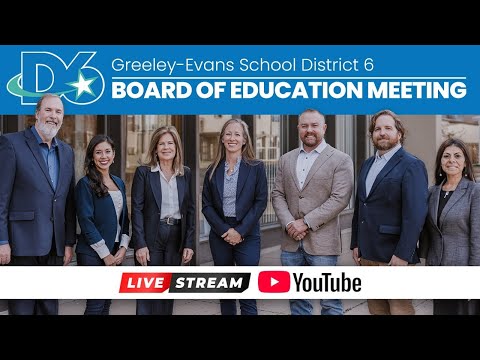
At the Feb. 9 work session, the Board of Education of Greeley‑Evans School District 6 received a legislative briefing from district legal counsel Nathan and discussed several bills and a proposed federal tax‑credit scholarship program.
Nathan began by directing trustees to a bill tracker compiled by the district’s lobbyist (Mendez Barkas & Associates) and summarized proposals that could affect district operations and compliance. On HB 26‑1050 (readiness plans), he said the bill would change requirements so readiness plans could be optional for some children who demonstrate proficiency; an amendment in committee also introduced parental discretion that could require districts to provide a plan at a parent’s request.
On HB 10‑28 (second‑language educational programs), Nathan said the bill would create a diploma endorsement for bilingualism and allow districts to arrange endorsements through outside entities if they do not offer them. Trustees asked practical questions about assessment format and who would administer any oral evaluations.
Nathan described HB 11‑41 as a proposal to create a state office with civil‑rights complaint authority for public schools; he and trustees noted concerns about overlapping standards with federal law and potential added liability and training burdens.
On SB 004 (expanding petitioners for extreme risk protection orders), Nathan said the bill would add educators and health practitioners to the list of people who may request emergency risk protection orders; trustees raised free‑speech and due‑process concerns and the district noted existing governmental immunity language in the draft.
Trustees discussed SB 057, a bill that would require director district residence (eliminating at‑large elections in certain districts under a size threshold). Nathan said Colorado Association of School Boards (CASB) opposes the proposal; trustees raised concerns about recruiting board candidates and administrative burdens if district elections move to ward‑style voting.
Nathan also updated trustees on SB 60, a bill proposing annual mental‑health training for coaches and a required notification process when students sustain concussions; he said the bill would impose significant training and administrative obligations on community coaches.
The meeting included an extended discussion of a new federal tax‑credit scholarship program under Public Law 01/1921. Nathan told trustees the program would allow individual taxpayers to direct up to $1,700 to scholarship‑granting organizations (SGOs) that can then award scholarships for private school tuition; he said Treasury rulemaking is ongoing and that the rules currently appear to limit state ability to impose guardrails on SGOs. “This program is gonna begin in January 2027,” Nathan said. Board members expressed concern that the program could divert federal funds away from public schools and that SGOs may not be subject to the same legal obligations as public districts. Nathan cited estimated annual national flows between $21 billion and $51 billion in one linked analysis and warned the district should monitor rulemaking closely.
Several trustees suggested the board consider a resolution to urge Governor Polis not to opt in to the federal program without guardrails; Nathan said staff will circulate background materials and watch committee calendars to identify when the board might take formal positions on specific bills.
No formal votes were taken during the work session; staff will continue monitoring bills, share updated analyses and, if warranted, bring formal position recommendations to the board.