Council reviews rental‑registration plan and limits on corporate ownership of single‑family homes
Loading...
Summary
A staff proposal would require web‑based registration for long‑term single‑family rentals, license entities owning 10+ units, and create a 'single‑family rental community' zoning path with ownership caps (draft language proposes a 25% common‑owner cap and up to 50% within a specially approved community). Council raised implementation, market and enforcement questions and asked staff to refine definitions and registration mechanics.
At a lengthy Feb. 10 council workshop, Kevin Wheelock presented a comprehensive proposal to regulate long‑term single‑family rentals through a web‑based registration system, a licensing requirement for large operators and a new conditional‑use option for single‑family rental communities.
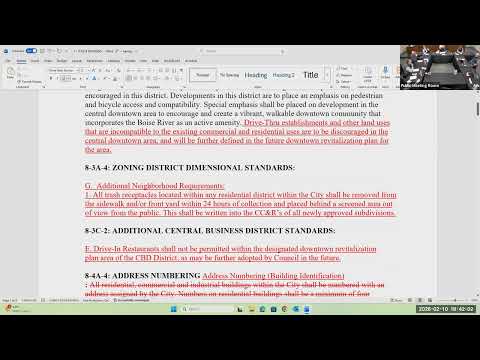
The draft has three linked pieces: a rental‑registration database to track owners and managers; a 'large operator' license for entities owning 10 or more single‑family rental units in the city; and a zoning path for neighborhoods that are intended to operate as rental communities under stricter design and management standards. The draft numbers in staff text include a cap limiting common ownership to 25% across a neighborhood in ordinary subdivisions and a higher share (the draft used 50%) allowed only in a purpose‑built single‑family rental community approved through a conditional use process.
Kevin said the ordinance is intended to help with public safety, code compliance and local management contactability—issues the police department flagged during internal conversations. He emphasized the intent is not to ban individual homeowners from renting but to constrain institutional, large‑scale purchase and centralized ownership models that convert whole neighborhoods to rentals.
Councilraised issues: how to treat existing legal nonconforming rental operations (staff proposes nonconforming status without expansion), whether buyers who acquire a rental portfolio should be required to divest units quickly or over time to meet percentage caps, market impacts of forcing sales, and administrative staffing and online licensing costs. Staff recommended using the existing iWORKS permitting/license portal for registration and keeping fees minimal to encourage compliance.
Next steps: staff will refine the ordinance language, explore module/fee options in iWORKS for registration, and return with adjusted percentages, transition language for existing developments, and legal review of market‑impact options.