Santa Rosa staff say 2025 water plan projects demand rising to 21,000 acre‑feet by 2050; supply judged sufficient
Loading...
Summary
Santa Rosa Water presented its 2025 Urban Water Management Plan update, projecting citywide demand from about 17,000 acre‑feet today to roughly 21,000 acre‑feet in 2050 while reporting supply (including a Sonoma Water allocation) is sufficient in near‑term drought scenarios; the plan and a water‑shortage appendix will go to the Board of Public Utilities in May for recommendation to City Council.
Santa Rosa Water staff told the Water Conservation Subcommittee that the city’s 2025 Urban Water Management Plan projects modest growth in water demand through 2050 but that contractual supplies and planned local sources should meet that demand.
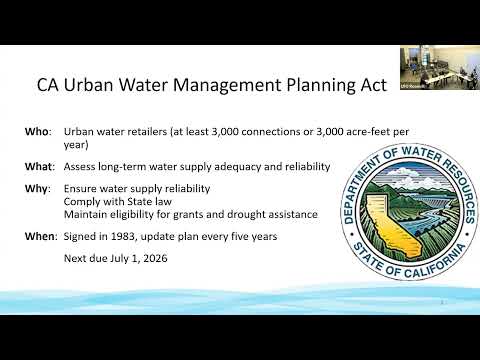
Claire Nordli, senior water resources planner, said the plan — required by state law every five years and due to the state on July 1 — uses the city general plan and past water use to project demand at least 25 years into the future. “We used specifically the general plan,” Nordli said, describing demographic and employment inputs used in the forecast. She reported the utility used about 17,000 acre‑feet last year and projects about 21,000 acre‑feet in 2050.
The plan treats passive conservation savings conservatively and excludes highly variable active program savings from baseline demand. Nordli said staff cap passive savings at the same level used in the 2020 plan “because we wanted to be as conservative as possible.”
On the supply side, Nordli said Santa Rosa’s contractual allocation from Sonoma Water is over 29,000 acre‑feet; recycled water system capacity is roughly 140 acre‑feet per year and groundwater currently supplies about 2,300 acre‑feet with plans to increase to about 4,100 acre‑feet. Staff noted those supplies, taken together, exceed projected demand in the near‑term drought outlook.
The UWMP also includes a drought risk assessment for the five years after the plan year. Nordli said the assessment shows supply remains higher than demand in every year from 2026 through 2030. The plan documents compliance with SBX7 per‑capita targets; Nordli reported Santa Rosa’s gallons‑per‑capita‑per‑day figures were about 96 in 2020 and 88 last year, well below the 126 gpcd statutory target.
Board members concentrated questions on whether the UWMP should explicitly call for regional collaboration, greater recycled‑water deployment and storage, and clearer evaluation of long‑running programs. Board Member Mullen pressed staff to include language on working with neighboring agencies on cost sharing for recycled water and regional storage; staff said the plan references the 2023 Water Supply Alternatives/Our Water Future planning work and that the supply chapter can and does point to potential regional options and technologies such as aquifer storage and recovery, potable reuse and stormwater capture.
Staff also acknowledged the policy challenge Mullen described: as customers adopt permanent conservation measures, the elastic response available during droughts can shrink. Nordli said there is still substantial outdoor savings potential and previewed an upcoming presentation on outdoor‑savings programs and nonfunctional turf.
Next steps: staff will post the draft plan for public review and distribute a bill insert to customers in February–March; the Board of Public Utilities is scheduled to review and recommend the plan in May, with a public review period in May–June and an anticipated City Council adoption in June before the July 1 state deadline.