
VSBA backs student representation but urges guardrails as H.640 would add voting student members to school boards
Get AI-powered insights, summaries, and transcripts
Subscribe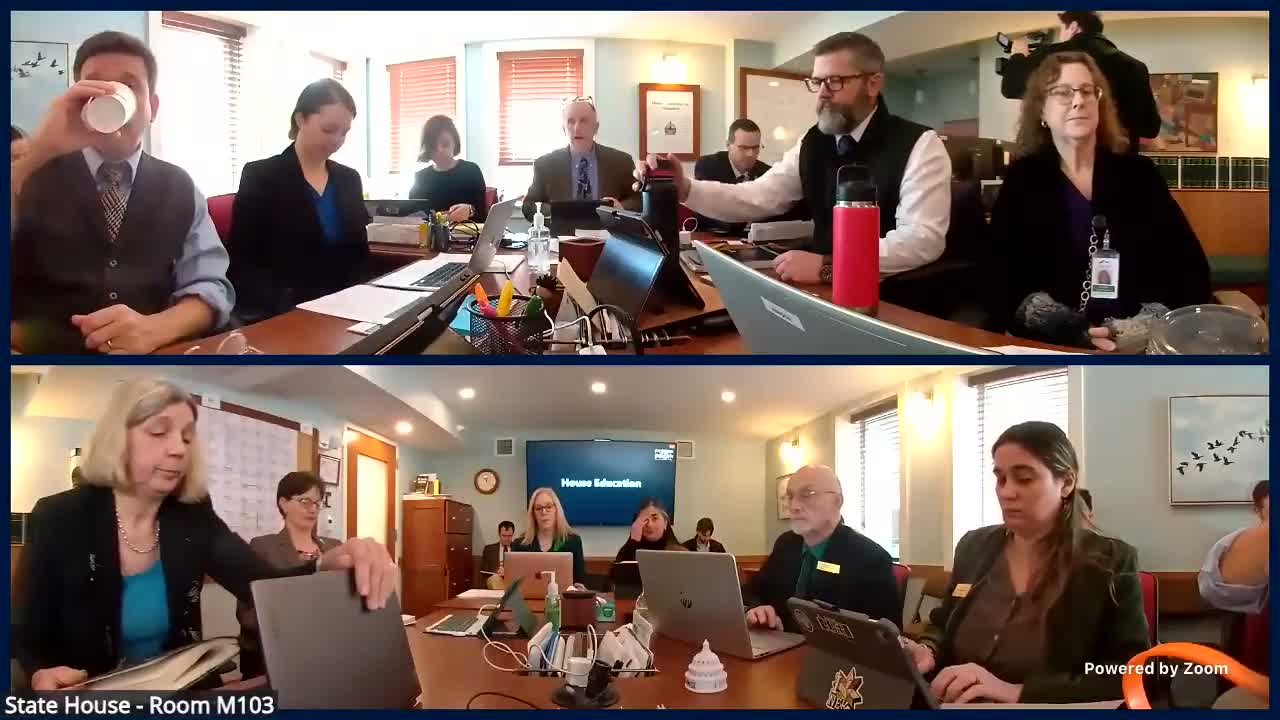
Summary
The Vermont School Boards Association told the House Education Committee that H.640 could strengthen student voice but raised legal, training and confidentiality concerns, noting available data show most student members now serve in advisory roles and that implementation will require clear rules and funded supports.
The House Education Committee heard Feb. 12 from the Vermont School Boards Association (VSBA) on H.640, a proposal that would require local school boards that serve grades 9–12 to seat four student members with voting rights (one per grade 9–12) and require boards serving grades 7–8 to include two nonvoting student members.
"As the people most directly impacted by board decisions, students bring insight, creativity, and honesty that can strengthen decision making and school climate," said Sue Zaglowski, executive director of the Vermont School Boards Association, testifying to the committee. The VSBA said it has long supported student participation and recently updated guidance and training to help boards include student voices.
VSBA summarized survey data from 37 school board chairs: 19 boards (51%) currently have student board members; the median number of student members was two; selection commonly occurs by principals via application and interview; and all 37 respondents reported student members do not now have full binding voting rights. The association cautioned that H.640, as written, would be more prescriptive than many current local practices.
The VSBA recommended the legislature resolve practical questions before imposing statewide mandates. "Allowing voting student board members may raise complex legal, constitutional and liability issues," Zaglowski said, urging the committee to consult legislative counsel on potential constitutional and liability implications. Committee members also noted Maryland has faced litigation over student board voting in the past; VSBA said it believed at least one Maryland case was decided in favor of student members but emphasized each state’s constitution differs.
Committee members pressed VSBA on guardrails: whether student members should attend executive sessions (superintendent evaluations and student hearings were cited as sensitive matters), what training and onboarding would look like, how selection would ensure fairness and accessibility, continuity across school years, and whether student communications would be subject to public records requests. VSBA said existing training for new school board members could be adapted and pointed to modules from the National Student Board Member Association tailored for students.
Several lawmakers asked whether student representation should be mandatory on all newly formed K–12 boards or left to local boards; VSBA representatives said the association’s board would favor student representation in principle but reiterated that statutory language should remain flexible so local boards can design appropriate structures and protections.
No formal vote or motion on H.640 was recorded in the provided transcript. The committee followed testimony with additional questions and requested supporting materials; VSBA agreed to provide its survey and the consultant study cited during testimony.