
Water Institute proposes Flood ID forecasting, model-sharing and capacity building for Region 9
Get AI-powered insights, summaries, and transcripts
Subscribe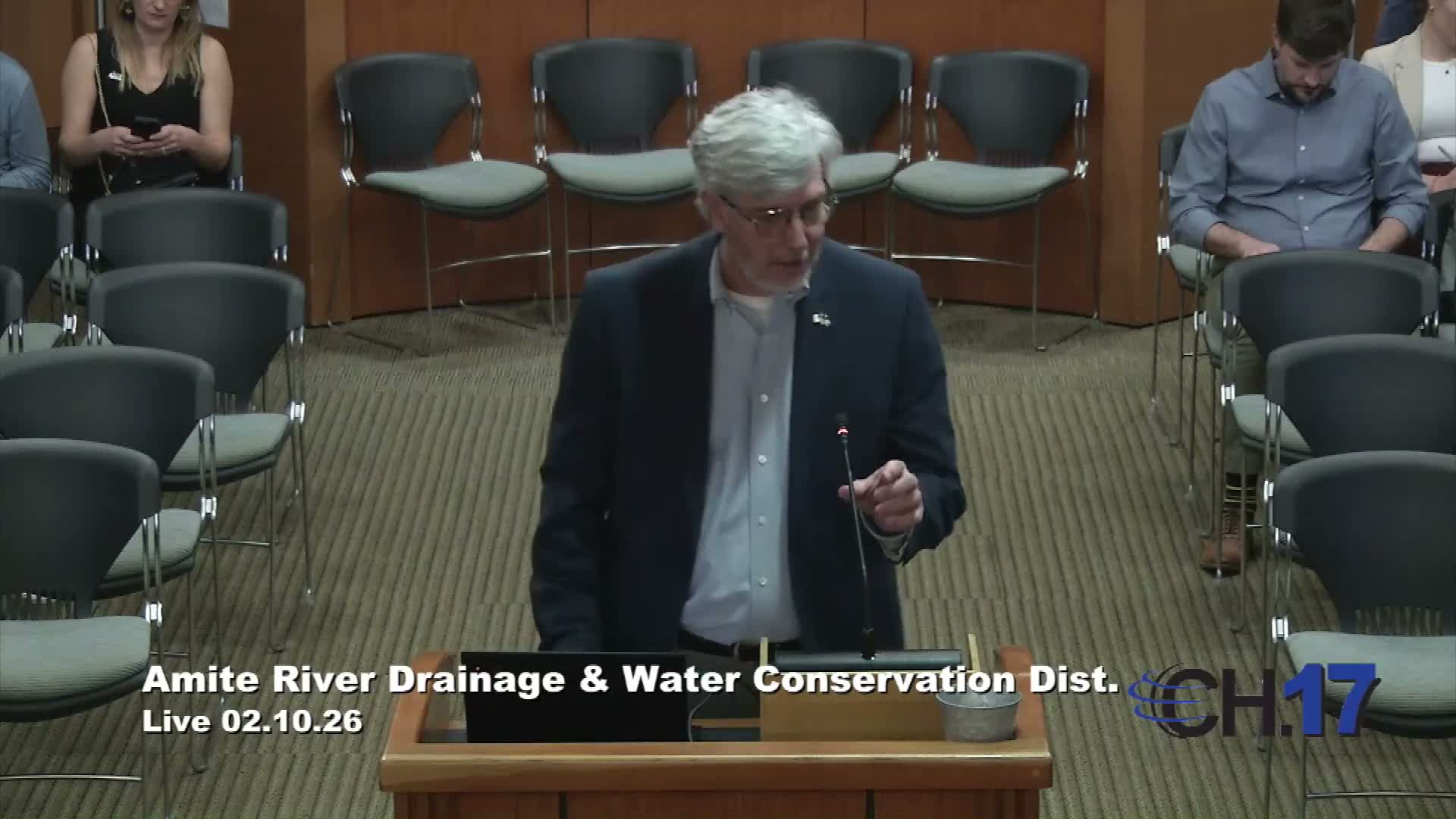
Summary
Garvin Pittman and the Water Institute presented a package of nonstructural actions to the Amite River Basin Commission on Feb. 10, proposing a Flood ID forecasting rollout north of I‑12, CRS participation, grant-management training and a public model repository while cautioning integration and ROI must be clarified.
At the Feb. 10 Amite River Basin Commission meeting in Livingston Parish, Garvin Pittman of the Water Institute presented a multi-part proposal to operationalize flood forecasting (Flood ID) inland, expand CRS participation, provide grant- and project-management training, and host regional hydrologic models for public use.
"This proposal is to make it operational for riverine as well," Pittman said, describing a plan to extend Flood ID from coastal areas north of I‑12 into the Amite River Basin. He estimated Phase 1 implementation at about $50,000 and Phase 2 at about $175,000 (assuming five participating communities), with an annual licensing cost for the Flood ID service of roughly $68,000 for both coastal and inland coverage. Pittman also proposed a $5,000 annual hosting license to make LWI and local models accessible to parishes and consultants.
Pittman framed the package as using existing regional capacity-building funds rather than requesting new appropriations. He told commissioners the approach could yield substantial CRS (Community Rating System) points — one slide cited up to 395 CRS points available from measures such as a real-time forecasting and flood-warning system — and that demonstrations would be available before any formal action.
Commissioners asked detailed questions about how Flood ID would integrate with existing local systems, gauges and other forecasting efforts. Commissioner Quintma and others requested a clearer explanation of how local parish systems, USGS gauges and separately developed models (for instance by Ascension Parish/LSU AI projects) would interoperate and what the local return on investment would be. LDOTD and other speakers flagged that some LWI gauges are not up to USGS standards and that data quality and gauge types (stage vs. discharge vs. rainfall) should be clarified before full adoption.
Pittman said the Water Institute could provide demonstrations and follow-up technical sessions and offered to run side-by-side comparisons with Central’s EarlyFlows system over an 18-month period to build confidence in inland forecasting accuracy.
Why it matters
Commissioners described forecasting and model accessibility as key to providing earlier, more targeted flood warnings to residents and to improving project delivery across the basin. If implemented and validated, the system could improve emergency preparedness, reduce insurance premiums for policyholders through CRS improvements and make local modeling efforts more reusable.
What’s next
No formal action was taken at the Feb. 10 meeting; staff said the idea is ripe for further diligence and will be returned as action items at a future meeting. The Water Institute offered to host demonstrations and technical briefings for commissioners and emergency-preparedness staff.