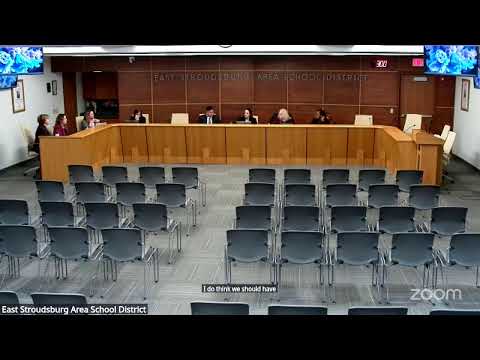
Curriculum committee forwards East Stroudsburg 2026–2029 comprehensive plan to full board
Loading...
Summary
After presentations and discussion of instructional priorities, the curriculum and instruction committee voted to forward the proposed 2026–2029 comprehensive plan — which emphasizes math teacher development (OGAP) and social-emotional learning — to the full East Stroudsburg Area School District board for approval and state submission.
The East Stroudsburg Area School District curriculum and instruction committee voted Thursday to forward a proposed 2026–2029 comprehensive plan to the full school board for approval and subsequent submission to the state. The plan identifies the district’s mission and vision as its guiding “North Star” and sets measurable three‑year goals in instructional improvement and social‑emotional learning.
During a presentation to the committee, the plan’s lead presenter said the district used a steering committee that included central office staff, building administrators, teachers, support staff, parents and students to draft the document. The presenter said the district’s needs assessment relied on the Future Ready PA index, identifying strengths in college‑and‑career measures and ELA growth and challenges in mathematics growth, Algebra I performance and the percent of students scoring proficient or advanced in ELA.
To address math challenges the plan recommends intensive professional development and coaching through the Ongoing Assessment Project (OGAP). The presenter described OGAP as “not a purchased curriculum” but rather a formative‑assessment and coaching program designed to help teachers tailor math instruction and improve numeracy instruction at the elementary level.
The plan also sets a three‑year goal for social‑emotional learning (SEL), saying the district will measure progress through staff surveys, walkthrough data and improvements in school climate indicators. The presenter highlighted that students participated in the steering process; one student recommended limiting computer‑based learning at older grade levels in favor of hands‑on experiences, and another said that computer work can challenge attention spans.
Committee members asked about testing and timelines. The presenter said the comprehensive plan and the presentation are posted on the district website and that the committee would be asked to move the plan to the full board for approval so it can be submitted to the state. The committee then made and seconded a motion to forward the plan; members voted by voice to approve the motion.
Next steps: the full board will consider the plan at a future meeting; if approved, the district will submit the comprehensive plan to the state as required.