
Moses Lake launches financial‑sustainability review after consultant warns of growing deficit
Get AI-powered insights, summaries, and transcripts
Subscribe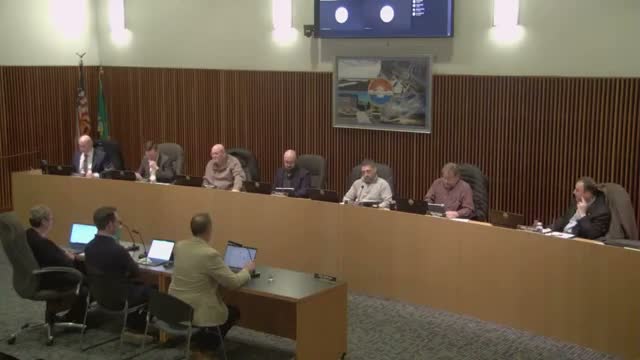
Summary
City staff and consultant Jeff Pooley presented an updated six‑year forecast showing a structural gap that grows from an estimated $1.5 million in 2026 to roughly $2.8 million in 2027 and widens thereafter; council approved a timeline for program prioritization and public engagement to close the gap.
Moses Lake City staff on Friday opened a citywide effort to “achieve financial sustainability,” presenting a six‑year forecast and a schedule for program‑level prioritization and public engagement.
Jeff Pooley, a consultant with Next Level Analytics, told the council the baseline forecast—built from the adopted 2026 budget and 2025 actuals—assumes staff salaries grow about 5% annually, medical costs rise faster than other expenses, property‑tax growth tied to new development at roughly 0.9%, and most other revenues at about 3% inflation. Pooley summarized the model by saying the forecast produces a starting deficit of about $1.5 million for 2026 and “the budget deficit in ’27 is 2,800,000.0,” which widens in the out years if no actions are taken.
City staff and Pooley also introduced a preliminary estimate for annual capital facility replacement for general‑fund assets. Using two rule‑of‑thumb methods (replacement‑value percentages and square‑footage comparables) the team presented a mid‑point estimate of roughly $1.8 million per year and a plausible range of $1 million–$3 million annually. Pooley and staff noted those are preliminary and will be refined after a planned consultant facilities assessment.
Rob (staff presenter; role/title not specified in the transcript) framed the exercise as a process rather than an immediate call for solutions. He described “service‑level budgeting” as the chosen lens: programs will be classified by the council as core (mandated or life‑safety), basic, or enhanced (discretionary) so the city can weigh reductions or revenue options against public priorities.
Council members asked detailed questions about what changed in the forecast—chiefly the roll‑off of one‑time funds such as ARPA and other grants—and about historical growth in staffing and facilities versus population. Staff said the forecast does not add positions or services beyond the adopted 2026 budget; instead it carries forward 2026 numbers and applies growth assumptions. Staff also noted that many grant programs are capital‑oriented and rarely pay for ongoing operations, and warned that pursuing grants for new assets can create ongoing maintenance obligations.
The council set a follow‑up schedule: a Feb. 24 meeting to sort programs into core/basic/enhanced, March public engagement including a March 16 workshop, a statistically valid survey and an online “balancing act” tool, and an April 14 return of the model with public input. Staff hopes to return an implementable financial‑sustainability plan for council approval by an April 28 meeting, with the aim of informing the council retreat in May and the 2027 budget process in June.
Staff emphasized tradeoffs the council will face: options include using banked levy capacity or a council‑manic 1% levy increase (not assumed in the baseline), voter‑approved bonds to finance major capital projects, or service reductions. Pooley noted that issuing debt for new police or fire stations would change the capital and operating picture and likely require voter approval and separate planning.
The council did not make immediate budget decisions. Instead members asked for further drill‑downs—staff growth vs. population, assets‑per‑capita trends, detailed SRO (school resource officer) accounting, and refined capital costs—before the Feb. 24 session when the program categorization exercise will begin.
Ending: Staff will refine facility replacement estimates after a consultant assessment, present revenue and expenditure tradeoffs on Feb. 24, run public engagement in March, and return model scenarios for council direction on April 14 with the goal of approving a plan in late April.