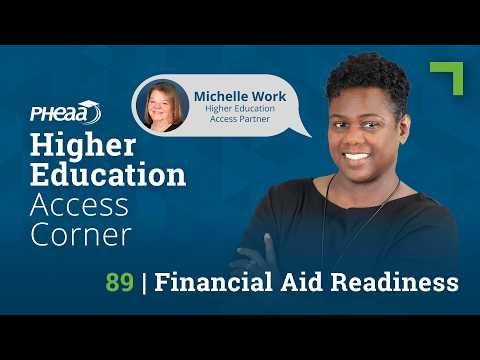
PHEAA podcast urges students to file FAFSA early, explains key deadlines and resources
Loading...
Summary
On the PHEAA Higher Education Access Corner, access partner Michelle Wirk urged families to complete the FAFSA, start college and career planning early, watch priority deadlines and use tools such as EdPlanner and My Smart Borrowing to compare costs and earnings potential.
Tiffany DeVan, host of the Pennsylvania Higher Education Assistance Agency’s Higher Education Access Corner, interviewed PHEAA access partner Michelle Wirk about Financial Aid Awareness Month and practical steps families can take to afford postsecondary education.
Wirk, who covers six counties in western Pennsylvania as a PHEAA access partner, said the starting point for most families is the Free Application for Federal Student Aid (FAFSA). "The form has been changed so dramatically, it is so simple to fill out," she said, and added that even households that expect not to qualify for federal aid should complete the FAFSA because colleges and scholarship programs use FAFSA data to determine many awards.
The episode emphasized timing. Wirk said the FAFSA opens Oct. 1 for students in their senior year and that many colleges set earlier priority deadlines — she cited Dec. 15 as an example — for awarding institutional aid. She also said the Pennsylvania State Grant generally uses a May 1 deadline prior to the academic year, with limited exceptions (for certain open-enrollment trade and technical programs) that can extend to Aug. 1 in particular cases.
Wirk recommended tools and in-person checks: PHEAA’s EdPlanner for career exploration and the My Smart Borrowing tool to compare projected earnings against college cost. "A college visit is key," she said, advising students to visit campuses (or use virtual tours), talk with financial-aid offices and meet current students to judge fit.
The episode also answered common questions and dispelled myths. Wirk warned against services that promise to "lower your SAI" for a fee, calling many such offers scams, and urged families to contact financial-aid offices to discuss competing offers. She recounted a case where a private college offered a $5,000 scholarship after being told a student had a better package from another school.
On parental loan defaults, Wirk clarified that a parent’s defaulted loan does not typically prevent a student from qualifying for federal grants or aid in the student’s name, although it can affect the parent’s own eligibility for federal student loans.
DeVan closed by noting PHEAA has 13 higher education access partners statewide and directing listeners to pheaa.org for contacts and resources.
The episode focused on practical steps — file the FAFSA when eligible, check school-specific priority deadlines, use available tools to estimate long-term impact of borrowing, and involve students in decisions — and directed listeners to PHEAA for localized help.