Powhatan County reviews FY27 budget scenarios and a 50/50 revenue-split proposal with schools
Loading...
Summary
At a Feb. 12 budget workshop, Powhatan County staff outlined three tax-rate scenarios (75¢, 77¢, 79¢), proposed splitting community-impacting tax revenues 50/50 with schools, and showed how each scenario affects county revenue, positions, and CIP funding; no formal votes were taken.
Powhatan County officials on Feb. 12 reviewed fiscal year 2027 budget scenarios and a staff proposal to split community-impacting tax revenues evenly with the school division.
County staff opened the workshop with an overview of themes and values guiding the FY27 plan, saying cost growth is outpacing natural revenue growth and that the county must prioritize compensation adjustments, align the capital-improvement program (CIP) with affordability and borrow more sparingly for routine maintenance. Staff identified three real-estate tax scenarios — 75¢, 77¢ and 79¢ — and described the projected revenue, transfers to schools and net county revenue for each.
Under staff projections presented at the meeting, a 75¢ real-estate tax rate would produce limited additional resources but balance the budget while funding a modest set of personnel requests (a comp-and-class adjustment, a 3% raise line, select positions such as a public information officer and a few offset positions). At 77¢, staff said the county could fund additional items (including three full-time EMS staff) and contribute more to fund balance. At 79¢, the model showed the largest contribution to fund balance (about $1.3 million) and would retain more positions; staff said the marginal increase to the annual tax bill on a $400,000 home would be roughly $160 under the 79¢ scenario.
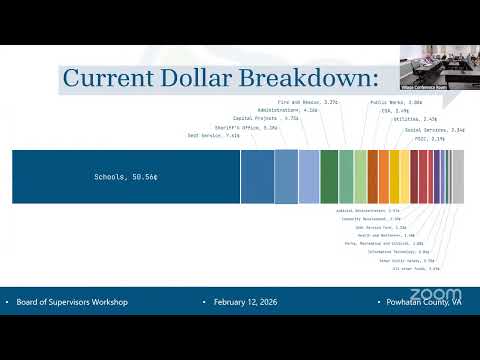
On school funding, staff proposed a revenue-splitting approach intended to be transparent: ‘‘we'd like to think about splitting revenues with the school,’’ a county presenter said, explaining that revenues that affect the entire community — general property taxes, local sales tax and consumption/utility taxes — would be split 50/50 while enterprise fees (building inspections, parks and recreation fees) would remain with the county. Staff gave a working example that roughly half of incremental local tax growth (about $4 million in the illustration) would translate to about $2 million for schools under the split.
Board members pressed staff on details the schools would request and on transparency of school spending. One board member raised concerns about giving a fixed percentage ‘‘if they don't need that’’ and asked how staff would identify the baseline against which any percent increase is measured; staff replied that additional visibility into the school division's operational request would be obtained as the FY27 process progresses.
Board members and staff also discussed fund-balance policy and debt capacity. Staff noted that Powhatan currently uses a 15% contribution threshold and that raising the target (for example toward 20%) could help improve the county's bond-rating profile; consultants from Davenport were referenced as the source of further modeling. Staff warned that certain planned CIP items — including a large HVAC project for Pocahontas Elementary — likely require debt and, under the most constrained scenarios, might not be affordable until later years; the staff presentation said the Pocahontas HVAC project could be approved in FY27 while its debt-service payments begin in FY28 to better match affordability.
On the CIP, staff said they are ‘‘rightsizing’’ the multi-year plan so it becomes a realistic work plan tied to revenue assumptions. Cash-funded projects proposed for FY27 included roof replacements, HVAC upgrades, the historic courthouse project, parks master-plan work and vehicle replacements (including school buses). The Oak Ridge pump station was raised as a specific utility project with updated preliminary costs (staff said an initial $3 million estimate had grown to about $7 million and that short-term, lower-cost pump alternatives are being considered).
No formal budget or tax-rate votes occurred at the workshop. Staff laid out next steps and statutory timing: the board will discuss which budget to advertise at its March 26 workshop (staff noted March deadlines for advertisement), the public hearing on the advertised tax rate is scheduled for April 6, and formal adoption would follow the required notice period. Staff emphasized that an advertised rate can be reduced before adoption but not increased after advertisement.
The workshop closed with staff and board agreement to continue refining revenue assumptions, obtain clearer school operational requests, and finalize advertising and public-hearing materials on the timetable presented.