Lifetime Citizen Portal Access — AI Briefings, Alerts & Unlimited Follows
Board reviews student assignment transition plan and plans two new highly capable cohorts in South Seattle
Loading...
Summary
Staff introduced the Student Assignment Transition Plan and said the district will open two new highly capable elementary cohort sites (Rainier View and Alki) with family enrollment decisions due March 31; directors raised concerns about site selection, program supports for multilingual and special education students, and communications timing.
The Seattle School Board on Feb. 11 heard an introduction (no vote) of the Student Assignment Transition Plan (SATP) that would open enrollment for two new highly capable (HiCap) elementary cohort sites in the South End — Rainier View and Alki — and move the open-enrollment timeline earlier in the year.
Chief Operating Officer Podesta told the board the district has already maintained existing HiCap cohorts and implemented changes to the open-enrollment timeline; staff are prepared to "open enrollment for 2 highly capable cohort sites on the South End" as soon as communications go out. Dr. Montgomery (executive staff for accelerated learning) said the district intends the new sites to mirror the acceleration in math and language-arts models used at existing HC sites and signaled families would have until March 31 to decide on HC placements.
Parents and teachers who testified earlier asked the board for neighborhood access to HiCap services and raised equity problems with recent changes in identification criteria. Christina Kip and Jen Jackson, parents and an educator, described students with qualifying achievement who now may be denied HC services under new criteria; Jackson said the new criteria are "riddled with errors" and urged reverting to last year's standards while the district consults test makers and independent evaluators.
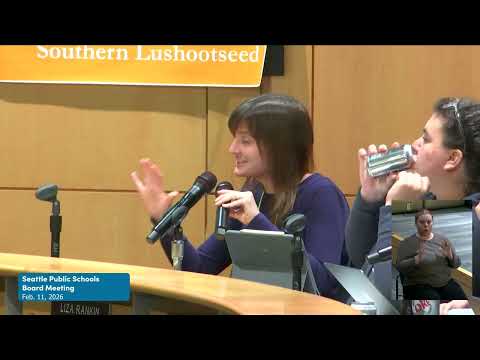
Directors pressed staff for documentation and monitoring measures. Director LaValle and others asked for clarity on site-selection criteria, feeder patterns and program modeling (for example, whether middle-school acceleration pathways will be available to students coming from these sites). Director Rankin emphasized the need for staff to present what success will look like and the metrics the board will use to evaluate the sites.
Staff said they had considered facility capacity, projected enrollment and school leadership readiness when choosing the sites and that the sites were intended to be sustainable, not temporary. Chief Operating Officer Podesta and Dr. Montgomery committed to follow-up briefings on program staffing, supports for multilingual learners and special-education students, and enrollment communications.