
Joint Finance examines corrections budget as DOC seeks $515.8 million; lawmakers focus on rising off‑site health costs and Plummer closure
Get AI-powered insights, summaries, and transcripts
Subscribe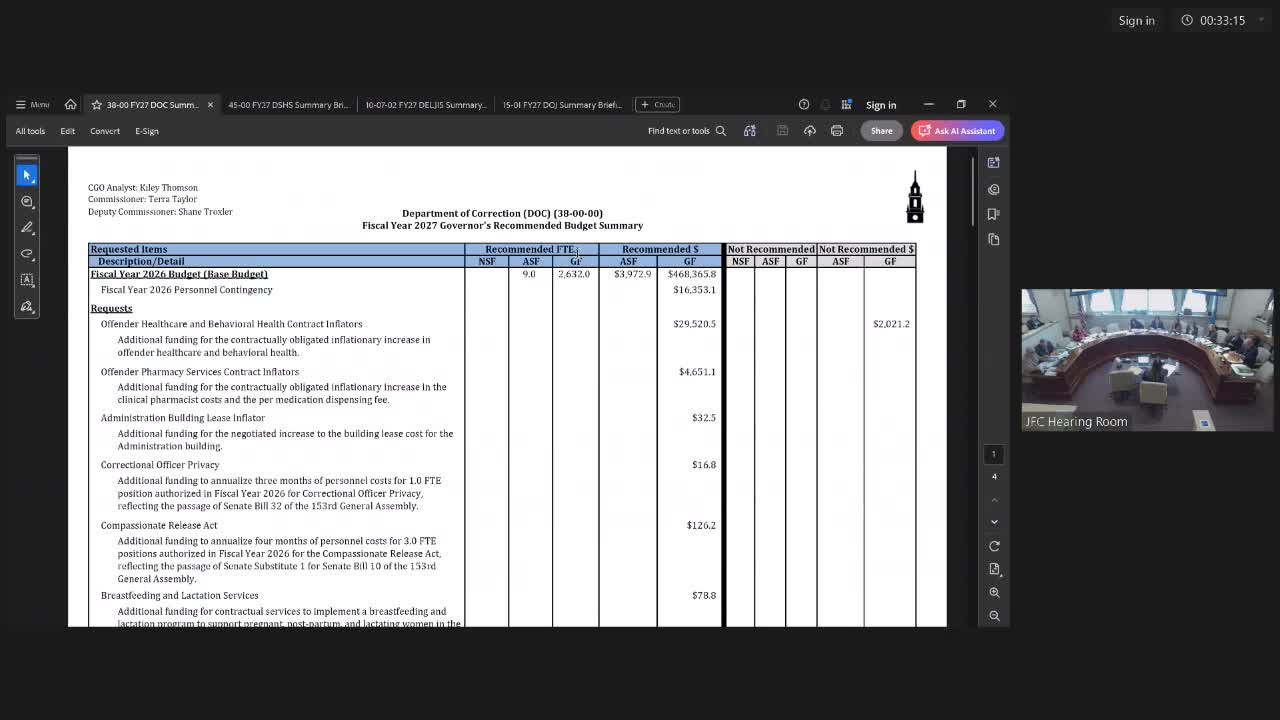
Summary
The Joint Finance Committee heard the Department of Correction’s FY27 operating request of $515,778,500 and pressed officials on steep off‑site medical and pharmacy contract costs. Commissioner Tara Taylor outlined staffing gains and plans to redeploy services after the planned closure of the Plummer Community Corrections Center, while members and nonprofit speakers urged stronger reentry supports and housing solutions.
The Joint Finance Committee on Feb. 6 reviewed the Delaware Department of Correction’s recommended FY27 operating budget, which Commissioner Tara Taylor said would total $515,778,500 under the governor’s proposal. Kylie Thompson of the Office of Management and Budget opened the orientation with line‑item figures and recommended additions, including roughly $29.5 million to fully fund offender healthcare and behavioral health contracts and $4.65 million for pharmacy contract inflation.
Why it matters: Committee members singled out off‑site medical costs and the budget impact of contracted healthcare services as a primary driver of growth. Those costs affect the state’s bottom line and the department’s ability to expand programs that support rehabilitation and reentry.
“The health care costs and and pharmacy costs are just killing us,” Chair Pardee said during questioning, summarizing members’ concern about the size of these contract increases. Commissioner Taylor told the committee much of the increase is driven by off‑site procedures and wage increases: “For a CT scan of the head, their negotiated rate, is $2,198. For Medicaid, it’s $178,” she said, noting DOC’s vendor, VitalCore, negotiates those rates directly with hospitals and that DOC has begun conversations with DHSS and providers to seek lower rates.
The department presented several other priorities categorized as "door openers": personnel contingencies to address salary needs, funding tied to the Compassionate Release Act and Officer Privacy Act, and smaller items such as lactation services and eStar licensing. Kylie Thompson summarized that many discretionary 1% requests were not recommended by OMB; several not‑recommended items may be covered through internal reallocations.
Plummer Community Corrections Center closure and reentry: Committee members pressed DOC officials about the planned closure of the Plummer Center and how residents and staff will be affected. Taylor said Plummer had a low population (about 17 residents at the time of testimony) and that the department will redeploy staff and transfer many residents to other Level 4 facilities with established work‑release transportation and programming. Taylor said operating savings included roughly $1 million reflected in the proposed operating budget and that some deferred maintenance funds tied to Plummer will be shifted to other facilities.
Taylor described a new Delaware Reentry Collaborative composed of cabinet secretaries and state agencies focused on eight goals, including improving access to official identification at release (exploring kiosks in facilities), strengthening workforce reentry and credentialing, expanding education and housing coordination, and removing policy barriers that impede employment for people with records.
Public comment and nonprofit perspectives: Representatives of Delaware nonprofits and training partners told the committee they support DOC’s reentry emphasis but urged stable funding for provider contracts, workforce training and housing. Speakers including Stacy Inglis of the Delaware Safety Council and Priscilla Turgeon of Project Newstart asked the committee to sustain grant‑in‑aid and reentry investments and to limit incarceration for technical probation violations that can disrupt employment and housing.
What comes next: The Joint Finance Committee recessed and will return for department‑level hearings; members requested additional detail on off‑site provider contracts, comparative rates paid by insurers (Aetna/Highmark), and a breakdown of victim services caseloads the Department of Justice and DOC referenced during orientations.