Get Full Government Meeting Transcripts, Videos, & Alerts Forever!
Get email alerts on the Impact Fees topic
No spam. Unsubscribe anytime.
Oakland consultant recommends higher impact fees as town plans extraordinary-circumstance workshops
Summary
A consultant told the Town of Oakland on June 10 that updated impact-fee calculations driven by recent growth and capital needs would raise municipal and utility fees; commissioners discussed timing, statutory limits and next steps including two extraordinary-circumstance workshops and ordinance readings in July.
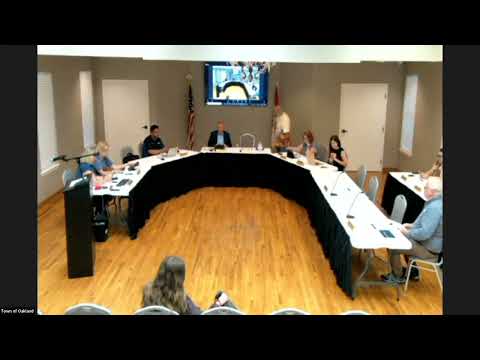
Oakland Commissioners heard a presentation June 10 on a 2025 impact-fee study that recommends raising several municipal and utility impact fees to help pay for planned police, administrative and water infrastructure. The consultant recommended the town adopt the calculated fees and proceed with two "extraordinary-circumstance" workshops required by Florida law when proposed fee increases exceed statutory thresholds.
Michelle Galvin, the consultant who presented the study, said the analysis updates the town's police, parks and recreation, administrative, water and wastewater impact fees using the capital improvement plan (CIP) and functional-population allocations. "So it is recommended that the town adopt the fees as calculated in full and move forward with the extraordinary circumstances," Galvin said during the workshop. She also noted that transportation fees were not part of this study and will be considered under a separate agreement.
Galvin described the capital needs behind the increases: about $840,000 in existing police investment plus a planned $3,000,000 expansion of the police station and roughly $1,400,000 estimated for additional police vehicles over the next 10 years. For water, the study assumed a $5,000,000 upgrade to the water plant plus roughly $2,400,000 in transmission improvements; wastewater fees rose in part because prior fees dated to 2017 and costs have since increased. Parks and recreation had an existing investment the consultant put near $3,000,000 and about $1,000,000 in planned growth-related improvements.
The consultant presented illustrative changes: two residential land classes would see increases in the 70—% to 80—% range for some municipal fees; on a combined municipal basis (police, parks, administrative) the study showed about an $880 increase (about 37%) for a single-family home. The combined water-and-wastewater increase was presented as about 26%, or roughly $774 per single-family connection. Galvin said Oakland would remain in the low-to-middle range compared with nearby communities on combined utility and municipal fees.
Commissioners pressed how methodology changes affected parks fees, and Galvin said statutory changes since 2021 tighten what can be included in parks impact-fee calculations; local CIP items must support any fee increase. Commissioners also discussed timing: the statute requires new fees be adopted within 12 months of a study, and several members said adopting now could preserve the study's value while others urged caution because large increases can attract state attention. "We have to make sure that we are following what's coming from Tallahassee," one commissioner said.
Galvin outlined the next steps she recommended: a second extraordinary-circumstance workshop on July 8, followed by a first reading of the ordinance at a regular meeting and a second reading and potential adoption on July 22. The consultant's recommendation in the workshop was not an adoption vote; the commission discussed options and statutory constraints but did not adopt the ordinance on June 10.
The consultant firm is identified in meeting materials and the presentation as RAFTELUS (the transcript contains two transcriptions of that name); the firm provided the study dated June 4, 2025. The commission will return to the matter at the listed July meetings before any formal ordinance adoption.
What's next: The commission scheduled the additional extraordinary-circumstance workshop and the ordinance readings; staff and consultants are expected to provide any requested clarifications about the CIP entries and permissible fee components before the first ordinance reading.