Get Full Government Meeting Transcripts, Videos, & Alerts Forever!
Get email alerts on the Council Procedures topic
No spam. Unsubscribe anytime.
Committee advances formal liaison policy and weighs broad rules overhaul, consent agendas and public-comment sign-in
Summary
The Committee on Council Processes agreed Aug. 11 to advance a previously approved council-liaison policy to the full Bloomington City Council for placement on its agenda while discussing a pending Title 2 overhaul, a code-of-conduct training for liaisons, implementation of QR-based public-comment sign-in and potential consent-agenda and time-limit rules to shorten meetings.
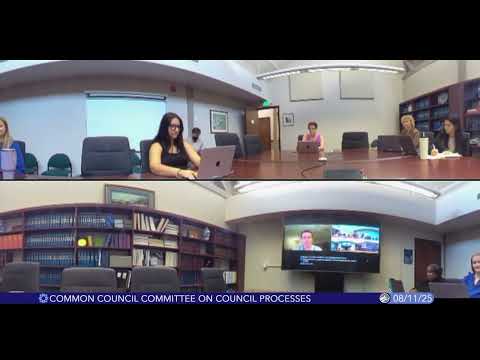
The Committee on Council Processes met Aug. 11 and agreed to forward a council-liaison policy — already approved by the full council in principle — to council leadership for placement on a future agenda.
"Looks good to me," Council Member Matt Clarity said of the liaison packet language, and a committee member said they would "draft an email to council leadership and staff" to request the item be scheduled. The committee emphasized the packet largely transfers the council-approved proposal into an official document for the city's website and municipal record.
Why it matters
If adopted in its final form, the liaison policy would formalize how council members communicate with board and commission chairs and staff liaisons, increase expectations for notice when legislation affects those bodies and provide a clearer channel for feedback from community advisory groups. Committee members and public commenters said clearer rules could improve coordination and public understanding of how nondepartmental entities interact with city business.
What the committee discussed
Staff told the committee the draft code of conduct intended for board and commission members is still under review with the city's legal team and is not yet final. A staff member described the plan to pair the code with training so new and existing commissioners and staff liaisons would sign the code and know the referral and removal processes "in case people need to be removed." The committee did not adopt language at the meeting; staff said they will continue refining the draft with the legal office.
The committee also addressed public-comment sign-in procedures. Chair Isabel Piedmont Smith noted council previously approved a sign-in system and asked staff if implementation remained on track for a target date of Sept. 3. Council staff and the clerk's office said coordination with ITS and display logistics for a QR code remain to be finalized; Deputy Clerk Jennifer Crossley said the clerk's office already has "one or two tablets" available for use during meetings.
A series of proposals aiming to shorten and streamline meetings drew extended discussion: committee members debated adopting a uniform time limit for presenters (one proposal floated was five minutes per presenter plus five minutes for questions), creating a consent agenda for routine items with an easy opt-out for members, and whether to permit substantive discussion at first reading or rely instead on third readings to avoid last-minute code conflicts. On the two approaches, members said each has trade-offs: third readings give staff more time to address cross-references, while limited first-reading discussion could reduce rushed amendments.
Public input and next steps
Terry Amsela, a Bloomington resident, urged the committee to make the liaison provisions practical so boards and commissions can effectively inform and educate the public about issues that come before the council. Christopher Amge of the Greater Bloomington Chamber of Commerce told the committee he supports consent agendas to shorten meetings and encouraged ensuring nonprofit presenters include a staff member so their remarks are tied to city priorities.
Committee staff pledged several follow-up steps: drafting an email to council leadership to place the liaison policy on a future agenda; continuing legal review of the code-of-conduct draft; coordinating ITS and the post office on QR-code display logistics; preparing a Google document to support scheduling and public-access parameters; and inviting administration representatives (legal and scheduling staff) to a subsequent meeting to discuss timing-related constraints on legislation. The committee also flagged an October scheduling conflict — the Oct. 13 meeting would fall on Indigenous Peoples' Day — and discussed moving the session to Oct. 6.
The committee did not take formal votes on the procedural proposals during the Aug. 11 meeting. Staff will return with refined drafts and recommended language for Title 2, consent-agenda rules, time limits and any proposed code amendments at a future meeting.