Get Full Government Meeting Transcripts, Videos, & Alerts Forever!
Get email alerts on the Zoning topic
No spam. Unsubscribe anytime.
Bloomington council narrows where storage, fuel and car-oriented uses can locate
Summary
The Bloomington Common Council on Aug. 6 adopted a package of Unified Development Ordinance amendments that reduce the zoning districts where self-service storage, vehicle fuel stations and vehicle washes are allowed and reclassify tattoo/piercing parlors as a personal-service use. Council approved the measures mostly unanimously.
In a move city officials said is meant to prioritize housing and street-activated uses over low-activity commercial sites, the Bloomington Common Council adopted several Unified Development Ordinance (UDO) changes on Aug. 6 that limit where self-service storage, vehicle fuel stations and vehicle washes may locate.
Development Services Manager Eric Gruelick told the council the package narrows the districts for a number of vehicle-oriented and storage uses "to just the MC zoning districts" and adds targeted use-specific standards. On the self-service storage amendment he said the proposal would allow the use "in the MC Zoning District only" and, in the Mixed Use Student Housing District, only as an accessory use if there are more than 20 dwelling units. He also described a maximum footprint standard: "not be more than 1,500 square feet or 20% of the property, whichever is less." (Eric Gruelick, Development Services Manager)
Why it matters
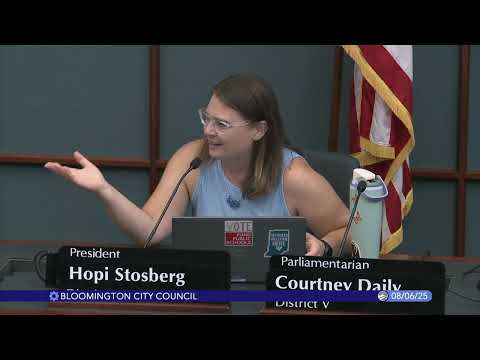
Council members framed the change as a modest step to keep marginal land available for housing and more active street-level uses. "They're real moneymakers for whoever develops them, but they are not really beneficial to the city in terms of activating the street," the council president said during debate, summarizing a point several members made in questioning staff about neighborhood impacts and long-term land use.
Key measures
- Self-service storage (Ordinance 20-25-25): Reduced to allowed use in the Mixed Use Corridor (MC) district and, in MS, only as accessory to properties with more than 20 dwelling units; new footprint and percent-of-lot limits were included. The council adopted the ordinance by roll call, 7–0. - Fraternity/sorority, artist studio, office, fleet operations housekeeping (Ordinance 20-25-26): The council approved a cleanup that removes an obsolete asterisk for fraternity/sorority references, adds artist studios and office as permitted uses in the Mixed Use Student Housing (MS) district and adds a missing asterisk to vehicle fleet operations referencing standards already adopted; an amendment to delete a redundant fraternity/sorority heading was adopted before final passage. - Vehicle fuel stations (Ordinance 20-25-27): The council limited fuel stations to the MC zoning district and removed several use-specific conditions tied to districts where the use is no longer allowed. Council members asked whether electrical vehicle charging would be affected; staff said EV chargers are generally treated as an ancillary installation and not a separate vehicle-fuel-station use. - Vehicle wash (Ordinance 20-25-28): Car washes were similarly narrowed to the MC district; an attachment error in the packet was replaced by an amendment before the ordinance passed. - Tattoo and piercing parlors (Ordinance 20-25-29): The council reclassified tattoo and piercing parlors as a personal-service use to allow broader placement in more districts.
Council reaction and votes
Council members asked multiple questions about nonconforming sites, whether existing facilities would be rendered nonconforming and consumer access (including for pedestrians and bicyclists). Gruelick told the council existing facilities could remain in business but could not expand in districts where a use is removed. After discussion and a short public comment period with minimal opposition, the package of ordinances moved forward; recorded roll-call votes on the primary amendments passed unanimously or by the tallies recorded in the meeting minutes.
What comes next
Staff said clarifications could be made to definitions—particularly to make clear that EV charging infrastructure is encouraged and not constrained as a fuel-station expansion—and the council directed staff to update web materials and UDO text where needed. Planning staff will handle the ministerial updates and posting of revised rules and tables. The council also scheduled a Sept. 10 deliberation session and additional public outreach on UDO topics.
Sources: Presentations and roll-call votes during the Aug. 6 Bloomington Common Council meeting; Development Services Manager Eric Gruelick.