Get Full Government Meeting Transcripts, Videos, & Alerts Forever!
Get email alerts on the Rezoning 210 N Lee topic
No spam. Unsubscribe anytime.
Plan Commission recommends rezoning of Rescue Mission site after heated neighborhood opposition
Summary
After extended public comment, the El Paso City Plan Commission voted to recommend rezoning 210 N. Lee St. from M-1 to C-4 to allow a group residential facility operated by the Rescue Mission of El Paso; neighborhood groups urged delay until the city's anti-displacement plan is in place.
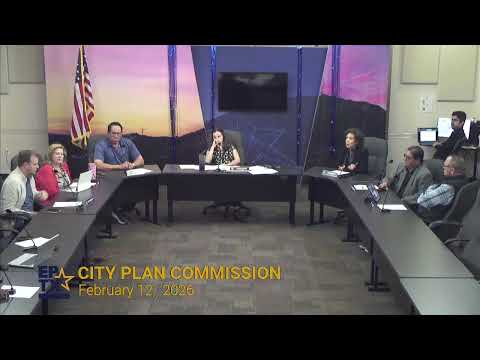
The El Paso City Plan Commission on Feb. 12 voted to recommend that City Council rezone a 2.11-acre property at 210 North Lee Street from M-1 (light manufacturing) to C-4, clearing the way for a group residential facility proposed by the Rescue Mission of El Paso.
Blake Barrow, chief executive officer of the Rescue Mission of El Paso, told the commission the project would rehabilitate a vacant 7,400-square-foot maintenance building and add expanded sanitary facilities to serve roughly 40 people inside the building, plus adjacent shaded space and a fenced green area for families. “We can provide water and sanitary facilities to that area,” Barrow said, describing separate fenced areas to keep family services distinct from spaces for people arriving off the street.
Neighborhood speakers said the commission should not move forward without stronger citywide protections against displacement and additional guarantees about how the facility would operate. Semeli de Aslan of Familia Unidas El Chamizal said residents are not opposed to housing but are concerned about an existing concentration of shelters, rehabs and services in South Central El Paso and the cumulative impacts on a neighborhood of mainly women, children and elders. “We are not anti-homeless,” de Aslan said. “We are a neighborhood of mostly women, children, and elders, and families who are dealing with the overload of the unhoused population in our neighborhood.”
Resident representatives cited an email from Veronica Carbajal of the Sembrando Esperanza Coalition, read into the record by staff, that urged commissioners to delay action until the city’s anti-displacement plan (the commission was told the city council voted to create that plan on 09/03/2025) is implemented. The email said the application understates likely neighborhood impacts and asked that residents have more time to evaluate any rezoning that could affect displacement risk.
Commission discussion focused on the regulatory limits of a zoning decision. Staff reminded the members that rezoning is a land-use decision that "runs with the land" and that C-4 is a broad commercial category that allows a range of future uses if ownership changes. Commissioners debated whether to seek a narrower zoning or attach conditions; one commissioner urged regulating the use rather than the user, but staff cautioned that rezoning to C-4 may reduce heavy industrial truck traffic by transitioning the district from M-1 manufacturing.
A motion to deny the rezoning failed after an unclear first roll call and procedural confusion on the record. The commission then voted to approve the rezoning recommendation; the clerk announced the motion carried and reported the vote as 4 yeas and 3 nays. The commission’s action is a recommendation only; City Council will consider the final rezoning and any conditions at a later meeting.
The Rescue Mission’s proposal, as described at the hearing, includes a drug- and alcohol-free 13-week rehabilitation program, additional restrooms and showers, a fenced play area for families, and a proposed green space behind the building. Barrow said the facility would coordinate with local detox services and that some residents served would be families with children and medically infirm people. “This is the condition that we’re building to remedy,” Barrow said of the number of people sleeping near the site.
Neighborhood leaders and residents asked the commission to consider the broader plan for South Central El Paso, the distribution of shelters and services, and whether infrastructure and city resources are sufficient to handle potential spillover. Commission staff and members emphasized that specific operational rules, parking counts and building standards would be handled at the building-permit stage and that an approved zoning would not itself set program specifics.
The commission forwarded its recommendation to City Council; council consideration and any potential conditions will determine whether the rezoning becomes final.