House committee advances bill to fund landscape‑scale forest health projects
Loading...
Summary
The House Appropriations Committee voted to report House Bill 78 Do Pass, creating a State Forestry cost‑share program (up to 75%) to fund large, cross‑boundary forest management projects aimed at protecting water supplies, reducing wildfire risk and leveraging federal and private matches.
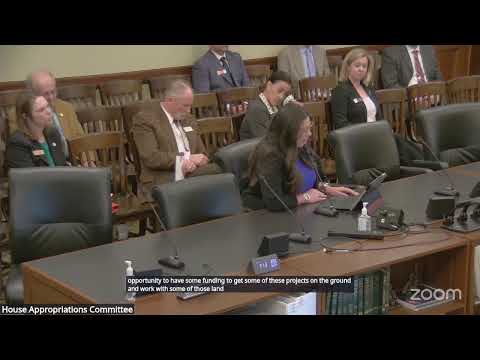
Cheyenne — The House Appropriations Committee voted to report House Bill 78 Do Pass after testimony from state foresters, municipal water managers, county officials and industry representatives who said a targeted cost‑share program could protect drinking‑water supplies and reduce the severity and cost of future wildfires.
Senator Hicks and State Forester Kelly Norris told the committee the proposal establishes a State Forestry‑administered cost‑share account to support silvicultural and multi‑use projects across federal, state and private lands. Norris said the program is structured as a cost share (up to 75% of project costs) so local partners must provide “skin in the game,” and that projects will be prioritized for large‑scale, cross‑boundary treatments that improve water yield/quality, reduce catastrophic wildfire risk, increase forest product production and improve habitat.
Norris described recent wildfire experience in Wyoming, citing the October 2024 Elk Fire near Sheridan and saying suppression costs for that event were about $48 million. She summarized academic and agency studies the committee had been provided showing hazardous‑fuels mitigation can produce multiple dollars in avoided suppression per dollar spent; based on those figures she estimated statewide suppression savings in the range of roughly $12 million to $21 million if the program is implemented as intended.
Norris also said the bill includes language enabling Good Neighbor Authority (GNA) projects and that the Select Water Committee added a 50/50 GNA provision during prior work. She told the committee federal competitive grants and private donations are expected to be combined with state funds; the fiscal plan presented to the committee anticipates appropriations of about $1.5 million in each of the first two years to seed the program.
Municipal water officials and local fire and industry representatives furnished case studies the committee found persuasive. Brad Brooks, director of the City of Cheyenne Board of Public Utilities, and Clint Bassett, Cheyenne’s water‑treatment manager, said prior collaborative treatments at Lake Owen and Rob Roy helped keep wildfire from seriously damaging municipal water collection and reduced post‑fire sediment and water‑quality problems. Rancher and Black Hills resident Speaker Nyman, county officials and timber‑industry witnesses described similar local benefits: improved water reliability for downstream irrigators, timber sales that can help seed further projects, and grazing or mechanical treatments that reduce fuel loads.
Representative Harrelson asked about a sunset provision in the bill that would stop grant approvals after July 1, 2030; Norris said that date was a compromise reached in earlier committee work and that the initial appropriations are expected to be spent quickly on prioritized projects. Norris confirmed private donations and other matching funds would be allowed under the program and that wildfire risk reduction is a named priority.
After public comment closed, Representative Harrelson moved to report the bill Do Pass; Representative Smith seconded. The roll call on the motion recorded seven 'aye' votes on the transcript and the committee reported the bill Do Pass.
The committee’s action forwards House Bill 78 to the next stage of the legislative process; committee members noted they may change the appropriation level during floor or conference work. The clerk recorded the roll call and the committee adjourned after a brief follow‑up meeting request.