
Germantown schools confront rising health and pharmacy costs; board presented $2.47M amendment and options to curb spending
Get AI-powered insights, summaries, and transcripts
Subscribe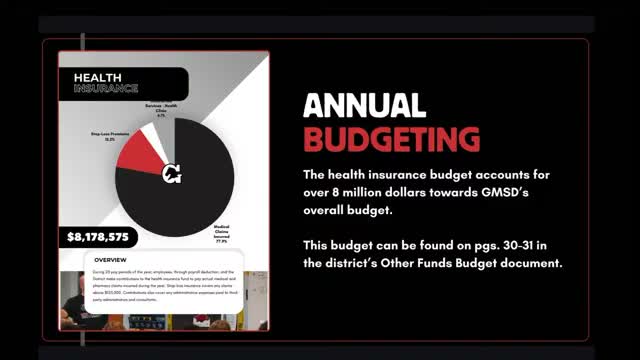
Summary
District staff told the Germantown Board of Education that medical and pharmacy claims have jumped, with pharmacy now nearly half of total claims, and proposed a $2,469,274 budget amendment and a $30,726 stop-loss premium amendment while presenting options including the Tennessee state health plan, a new pharmacy benefits manager, and internal plan design changes.
At a February work session, Germantown School District staff told the school board that the district's self-funded health insurance plan has seen a sharp increase in costs and proposed budget changes to cover higher-than-expected claims.
"GMSD is allocated over $8,000,000 towards the health insurance budget," Speaker 6 told the board, outlining revenue sources (employee and employer premiums, pharmacy rebates and reserves) and the plan's major expenditures, including medical and pharmacy claims, stop-loss premiums, the district health clinic and administrative services.
Staff said claims that had averaged $3–4 million per year rose to about $7 million most recently, with pharmacy spending increasing substantially. Speaker 6 said pharmacy now represents nearly 50% of total claims and that, "we are experiencing an almost 12% decrease in per member per month pharmacy costs based upon this time last year" after recent formulary and biosimilar steps took effect.
To cover the current fiscal-year shortfall, staff said they will present budget amendment No. 7 at the district's business meeting: "we are asking for a budget amendment, for $2,469,274 to shore up our medical plan and prescription claims for the rest of the year," Speaker 6 said. Staff also identified a confirmed stop-loss renewal of $1,130,726 versus the $1,100,000 originally budgeted, and will request an additional $30,726 to cover that renewal.
Board members and staff discussed three broad response paths: (1) immediately changing the local plan design (higher premiums/co-pays/out-of-pocket maximums and specialty drug co-pays), (2) pursuing a new pharmacy benefits manager (PBM) or going out to a PBM request for proposals, or (3) pursuing the Tennessee state health insurance plan. Staff said the district raised employee premiums by 5% for FY25–26 and has implemented a clinical-outcomes formulary and a biosimilar requirement, steps staff said are already showing early pharmacy cost reductions.
On the state-plan option, Speaker 6 said GMSD could determine employer and employee premium shares but the state controls annual premium-rate increases; staff also said joining the state plan would require a vote by eligible employees and retirees (50% must vote yes) and an MOU approved by the board. Staff cautioned the state plan could have higher specialty-drug cost-sharing and no district clinic: "the state does not offer a clinic for folks to utilize if they were on the plan," Speaker 6 said.
About vendor options, staff noted the district is in year two of a three-year contract with its current PBM (named in the presentation as WellDyne/WellDone) and that a vendor identified as MedBin Rx indicated it might realize roughly $500,000 in savings based on utilization — a figure staff described as a rough estimate that would require deeper analysis and an RFP. Speaker 6 said breaking the current PBM contract would require 180 days' notice and staff outlined implementation timelines that would be needed for any transition.
Board members emphasized caution about moving quickly. Speaker 4 said the state-plan option was "completely off the table" for them personally because it would eliminate the district clinic and could add costs by creating an additional retiree cohort that was not planned for. Several members urged a multi-pronged approach: keep implementing internal plan changes while preparing an RFP and budget adjustments as needed.
Staff also described short-term cash-management steps already taken: reimbursements from the district's OPEB account are being processed monthly rather than quarterly to ease cash flow; staff noted the health insurance account received $313,601 in retiree claims and prescription reimbursements from OPEB in January.
The board did not take a formal vote on any of the options during the work session; staff said the proposed budget amendments will be brought to the business meeting for formal consideration. "I don't feel that there's a will of the board to make any changes at the February meeting for as far as action items," Speaker 4 said near the end of the discussion.
What happens next: staff will bring the two budget amendments (the $2,469,274 medical/pharmacy amendment and the $30,726 stop-loss premium amendment) to the next business meeting, continue to monitor the formulary changes, and, if directed, proceed with a PBM RFP and necessary implementation planning.