
Lake County residents urge board for temporary moratorium on mobile‑home park pass‑through fees
Get AI-powered insights, summaries, and transcripts
Subscribe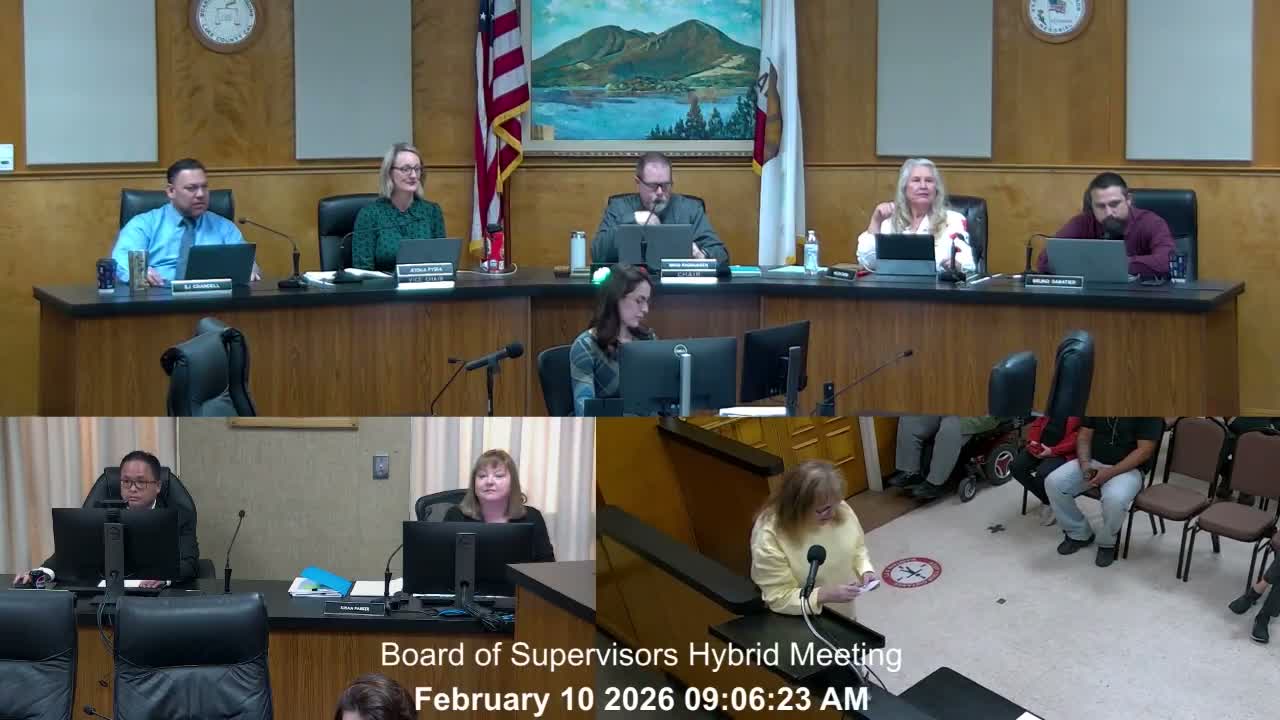
Summary
Residents of Sterling Shores Mobile Home Park and tenant advocates told the Lake County Board of Supervisors that a park owner has sent notices demanding roughly $450,000 in pass‑through charges and asked the board to enact a temporary moratorium on pass‑through fees and rent increases while a rent‑stabilization ordinance is developed.
Residents of a Lake County mobile‑home park urged the Lake County Board of Supervisors during public comment to enact a temporary moratorium on pass‑through fees and rent increases, saying an owner’s recent notice would saddle seniors and low‑income tenants with large, multi‑year charges.
“My name is Laura Ashley, and I live at Sterling Shores Mobile Home Park,” said Laura Ashley, who asked supervisors to protect low‑income, disabled and senior residents while the board develops a rent‑stabilization ordinance. “We need your protection while you take the time you need to develop a strong ordinance.”
Why it matters: Residents said the notices would lock tenants into added monthly fees for years and that many residents live on fixed incomes, rely on Social Security, or face medical costs. Several speakers said the charges come on top of recent rent increases and leave residents with little option to relocate because they own their homes but rent the land.
What residents told the board: Maya Lin, a Sterling Shores resident, said the park owner — identified in comments as Caritas Corporation — delivered a notice claiming about $450,000 in pass‑through capital expenses and warned of a roughly 7% increase in monthly fees beginning March 1. Lin also said the park had previously raised rents by 6% in 2023, 4.5% in 2024 and 5% in 2025.
“We can only pay and pay and pay whatever they want,” Lin said. “Please pass a moratorium before March 1 on rent increases and pass‑through fees.”
Multiple residents described the same pattern. Steve Zirker said residents who bought their manufactured homes are nonetheless "captive" to park fee changes; Cynthia Sims said a recent $60 monthly fee was demanded shortly after a rent increase and that she and her husband live on Social Security. Robert Sims said the park’s maintenance has declined and that the owner’s notice claimed the residents collectively owed $450,000.
Advocates and legal complaints: Jody Johnson, vice president of Zone A1 of the Golden State Manufactured Homeowners League (GSMOL), urged a moratorium and said arbitration experience shows pass‑throughs frequently benefit park owners rather than residents. Hillary Mosher, volunteer regional manager for GSMOL, said the owners’ pass‑through was framed as a non‑rent charge spread over 10 years and alleged the fee appears intended to recoup past operating income rather than fund new capital; she also said she has filed a complaint with the California Attorney General’s office regarding the owner’s nonprofit status. Mosher urged supervisors to place a moratorium on the agenda for the board’s Feb. 24 meeting.
Board action: No formal motion or vote occurred during the public comment period. Speakers repeatedly asked supervisors to add a temporary moratorium on pass‑through charges and rent increases to a future agenda for a formal vote; Hillary Mosher specifically requested the Feb. 24 meeting be used to consider the moratorium.
Claims and verification: Financial figures cited at the microphone — including the $450,000 pass‑through total, the 7% monthly fee increase, and an asserted CEO salary of $300,000 mentioned by a speaker — were presented by residents and advocates during public comment and were not independently verified at the meeting. Speakers also used slightly different names for the owner in comments (some said "Caritas Corporation" while one speaker used a different phonetic rendering); the board did not receive an on‑the‑record response from the owner during the session.
What’s next: Public comment closed with no immediate board decision recorded. Residents and advocates asked the board to act quickly to place a temporary moratorium on a future agenda while staff and the ad hoc committee continue work on a rent‑stabilization ordinance.