Get Full Government Meeting Transcripts, Videos, & Alerts Forever!
Get email alerts on the Energy Ocpa Feasibility topic
No spam. Unsubscribe anytime.
Stanton council receives OCPA feasibility briefing as residents raise transparency and financial concerns
Summary
Joe Mosca of the Orange County Power Authority presented a feasibility analysis to Stanton’s council outlining potential membership benefits — including a default ‘basic’ product about 3% cheaper on generation — while residents at public comment expressed strong opposition citing Irvine and Huntington Beach withdrawals and concerns about transparency and financial risk.
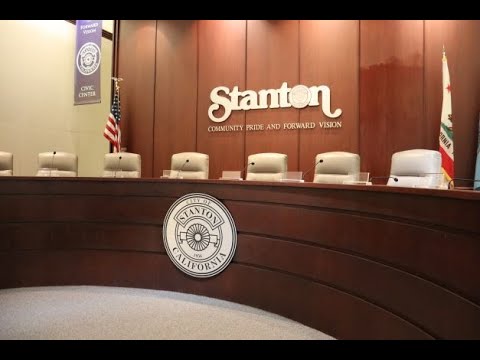
The Stanton City Council heard a feasibility presentation from the Orange County Power Authority (OCPA) on April 8 as council members requested further financial and contractual detail and dozens of residents weighed in during public comment.
Joe Mosca, OCPA chief executive officer, presented the study his agency commissioned from Pacific Energy Advisors and described how a community choice aggregator (CCA) works under state law (AB 117). He said the feasibility study asked whether it is financially feasible for OCPA to include Stanton and whether membership would be in Stanton residents' interest. "We pulled that electric load data from Southern California Edison," Mosca said, describing the data collection and the statutory process required to amend OCPA's implementation plan.
Mosca described three customer product options: a basic choice (about 47% renewable), a smart choice (about 55% renewable / 40% carbon‑free) and a 100% clean option. He said the feasibility analysis supports launching Stanton on the basic choice as the default and that the basic product would yield generation savings versus Southern California Edison's equivalent generation rate. "The basic choice is 3% less as the equivalent generation rate," Mosca said. He also highlighted customer programs OCPA offers or plans to offer, including an incentive finder, a marketplace for discounted efficiency products, a proposed $1,000 rebate for residential solar and battery installations, and a proposed program to distribute level‑2 EV chargers (retail value about $500) to customers through OCPA's marketplace.
Council members pressed OCPA on governance, membership history and financial exposure. Mosca acknowledged two member jurisdictions previously left or paused (Huntington Beach and the County of Orange at different stages) and pointed to audits and corrective measures OCPA has undertaken. He told the council OCPA expects to end the fiscal year with a roughly $17 million contribution to reserves and projected about $62 million in operational reserves at year end. He said Irvine provided early seed funding and that OCPA still has an outstanding loan to Irvine of about $7 million under an agreement that schedules repayment in 2027.
Mosca and staff described opt‑out mechanics and customer outreach: state law requires new CCA service to default customers to the chosen CCA provider, but residents may opt back to SCE; OCPA said it will run a robust community communications campaign, including a two‑month enrollment window and translated materials for non‑English speakers. On billing and outages, Mosca said Southern California Edison would remain the delivery utility and billing agent; OCPA would appear on the generation line of the bill.
After the presentation, the council moved public comment earlier in the agenda. Dozens of residents spoke on the OCPA item. Several residents who identified themselves as Irvine or Orange County residents urged Stanton not to join OCPA, pointing to Irvine's December 2024 unanimous vote signaling intent to withdraw, reports of financial shortfalls, and what they described as insufficient transparency about power purchases and contract risk. "You've just heard an hour and a quarter or more of utter nonsense," said Harvey Ellis (a former assistant professor of civil engineering) referring to the presentation; other speakers alleged the CCA charges a premium or fails to deliver additional renewable power to the grid. Supporters, including an OCPA board member who spoke during public comment, emphasized local control and modest rate savings and urged the council to weigh programs and local benefits.
Council members did not vote or adopt any ordinance or resolution at the meeting. Mosca and his team said they would return with a deeper dive into the finances and provide the city attorney and staff with the draft JPA and implementation materials for review. Council members asked staff to schedule follow‑up briefings with OCPA's finance team and legal counsel before any policy vote.
Next steps: Council requested more detailed budget and contract analysis from OCPA (including municipal impacts such as street light accounts and mobile home park billing), a staff review from the city finance/legal teams and a return presentation that includes the OCPA CFO and Pacific Energy Advisors.