Get Full Government Meeting Transcripts, Videos, & Alerts Forever!
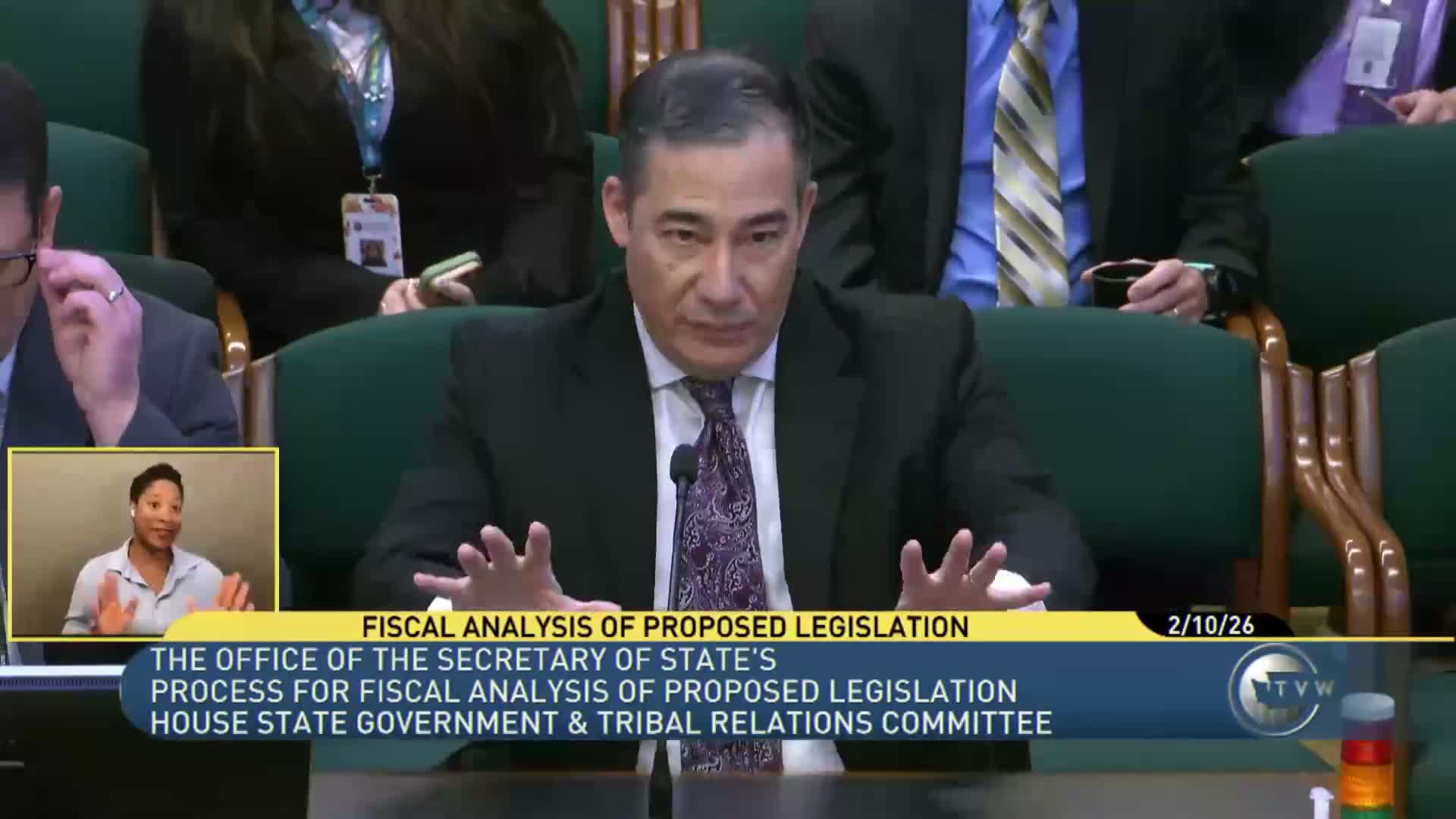
Secretary of State outlines fiscal note process and election-cost drivers, flags litigation uncertainty
Summary
Secretary of State Steve Hobbs and Secretary of State staff told a legislative committee the agency uses a three-day fiscal-note process that converts task estimates into FTE counts and includes a per-FTE "backpack" of roughly $28,000 and a 15% admin allocation; staff also discussed litigation assumptions under the Washington Voting Rights Act and costs tied to implementing ranked-choice voting.
Secretary of State Steve Hobbs and his staff briefed the State Government Tribal Relations Committee on how the office prepares fiscal notes, estimates litigation costs, and approaches costs tied to election changes such as ranked-choice voting.
Hobbs opened by saying his office has expanded efforts on cyber capabilities, disinformation response, and civic engagement (including targeted work for rural and tribal communities) but has had to reallocate internal funds because those efforts are not fully appropriated.
Tim Gallivan, the Secretary of State's budget and procurement manager, described a structured fiscal-note process with a three-day turnaround after an OFM assignment. "Our fiscal note process is a 3 day turnaround," Gallivan said, describing day-by-day…
Already have an account? Log in
Subscribe to keep reading
Unlock the rest of this article — and every article on Citizen Portal.
- Unlimited articles
- AI-powered breakdowns of topics, speakers, decisions, and budgets
- Instant alerts when your location has a new meeting
- Follow topics and more locations
- 1,000 AI Insights / month, plus AI Chat