
Secretary of State outlines fiscal note process and election-cost drivers, flags litigation uncertainty
Get AI-powered insights, summaries, and transcripts
Sign Up Free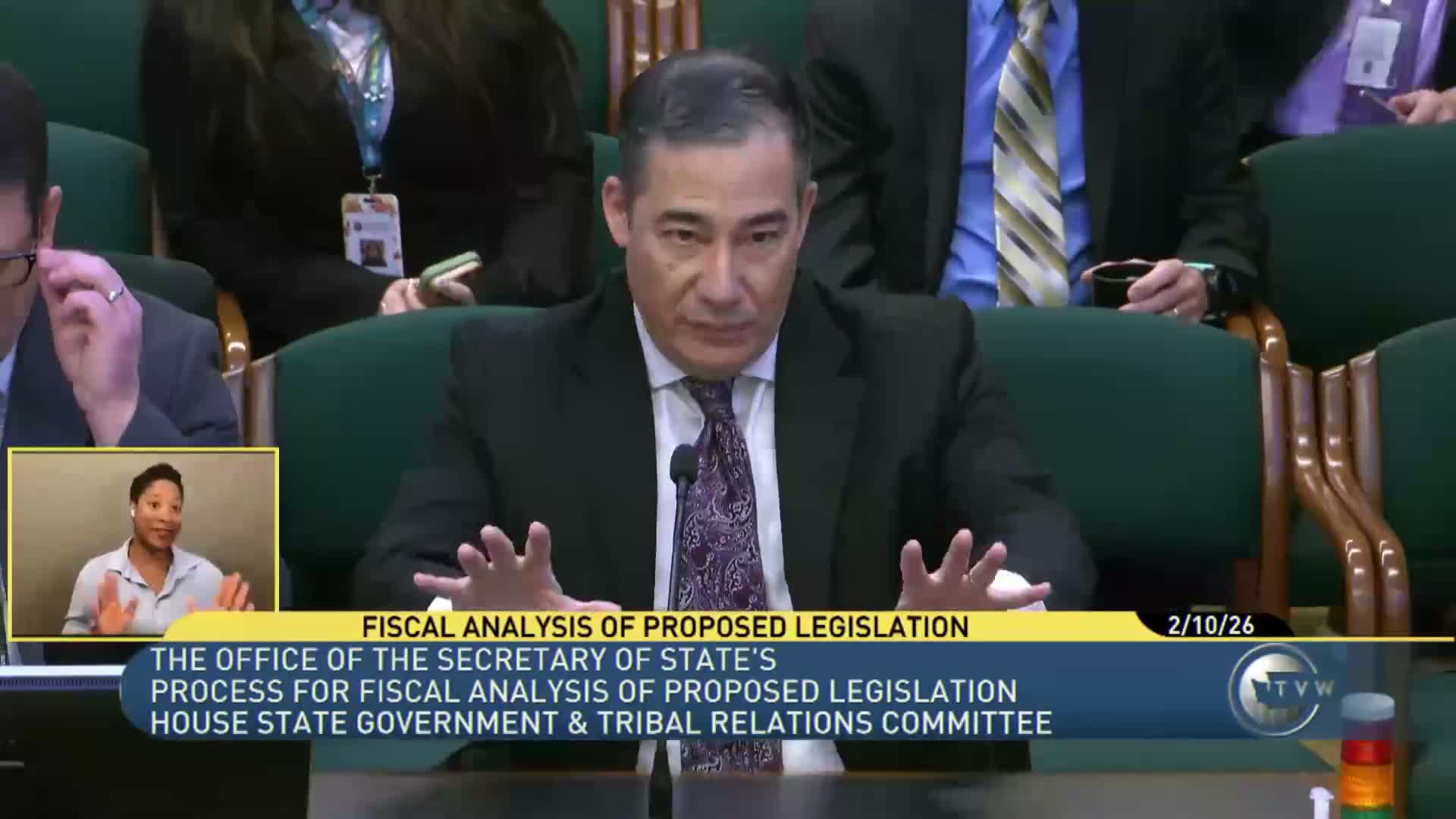
Summary
Secretary of State Steve Hobbs and Secretary of State staff told a legislative committee the agency uses a three-day fiscal-note process that converts task estimates into FTE counts and includes a per-FTE "backpack" of roughly $28,000 and a 15% admin allocation; staff also discussed litigation assumptions under the Washington Voting Rights Act and costs tied to implementing ranked-choice voting.
Secretary of State Steve Hobbs and his staff briefed the State Government Tribal Relations Committee on how the office prepares fiscal notes, estimates litigation costs, and approaches costs tied to election changes such as ranked-choice voting.
Hobbs opened by saying his office has expanded efforts on cyber capabilities, disinformation response, and civic engagement (including targeted work for rural and tribal communities) but has had to reallocate internal funds because those efforts are not fully appropriated.
Tim Gallivan, the Secretary of State's budget and procurement manager, described a structured fiscal-note process with a three-day turnaround after an OFM assignment. "Our fiscal note process is a 3 day turnaround," Gallivan said, describing day-by-day steps: assignment and scoping; subject-matter coordination and cross-division work; and divisional review and submission to OFM. He explained fiscal notes are assumption-based and emphasized neutrality: estimates are tied to the bill text, not presumed intent.
Gallivan outlined components beyond salary and benefits that the office consistently includes: an "employee backpack" of baseline operating costs (he cited about $28,000 per FTE) and an admin allocation that covers central support functions (cited at about 15% of salaries and benefits). He also described methods for estimating litigation costs in coordination with the attorney general's office, including mirroring AGO estimates when provided, using comparable prior litigation, or marking costs as indeterminate when too uncertain.
Stuart Holmes, director of elections, discussed litigation risk and why the office had previously included litigation assumptions tied to the Washington Voting Rights Act. Holmes cited recent signature-verification challenges and litigation trends in other states (for example, electronic-signature rules in Colorado and disputes in Mississippi and Louisiana) as factors that can change litigation risk assessments. He also said the office is moving toward seeking supplemental funding after suits arise rather than routinely assuming a fixed number of cases in advance.
Committee members asked how assumptions are formed for bills such as House Bill 1750 (Washington Voting Rights Act-related litigation assumptions) and House Bill 2210 (proportional ranked-choice voting). On ranked-choice voting, Holmes said rule-making work is relatively absorbable but the primary cost driver is system updates to support multiple ranked-choice methods and the need for a subject-matter expert to support counties; Hobbs and others noted significant public-education costs, citing a prior Pierce County expense of about $2,000,000 for voter education under an earlier implementation.
A procedural clarification: county auditors procure voting systems locally; the state certifies systems for use but does not purchase or recommend a specific vendor.
Next steps: staff offered to provide more detailed written information and to share fiscal-note backups on request; the committee closed the work session without taking committee-level action.