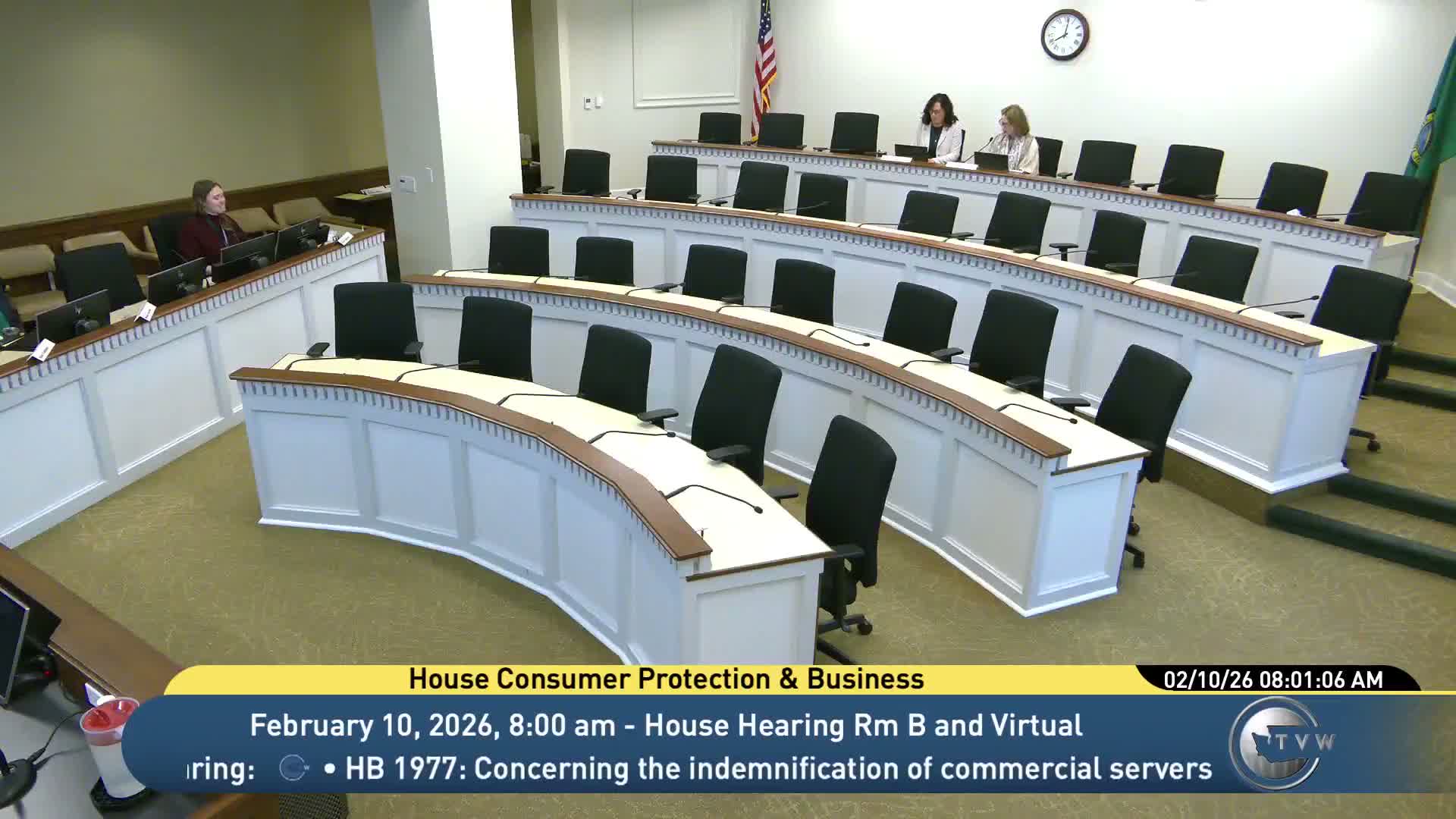
House Bill 1977 hearing spotlights server indemnification and strained liquor‑liability market
Get AI-powered insights, summaries, and transcripts
SubscribeSummary
Lawmakers held a public hearing on House Bill 1977, which would require retailers to pay defense costs and any civil judgments against servers accused of overserving; sponsor and industry witnesses said the measure targets workers who follow rules while the hospitality sector warned of a broken, costly liquor‑liability insurance market.
A legislative committee on Tuesday heard staff and industry testimony on House Bill 1977, which would require a retailer to pay the legal defense costs and any civil judgments against a server accused of selling liquor to a person apparently under the influence.
The bill, explained by committee staffer Peter Klotfelter, does not change administrative enforcement: the Liquor and Cannabis Board can still assess fines and suspend or cancel licenses. Klotfelter told members that the LCB’s administrative penalties for a licensed business include a five‑day suspension or a $500 fine for a first violation, a seven‑day suspension for a second within two years, a 30‑day suspension for a third, and possible license cancellation for a fourth; servers face smaller administrative fines.
Sponsor Representative Donaghy said the measure is intended to protect servers who follow the law from being financially ruined when they are named in civil suits. "This legislation is not about servers who willfully over serve," Donaghy said, adding that the aim is to prevent a server who is not found liable from "losing everything." She said the term "indemnification" was used as a practical starting point and may be refined with stakeholder input.
Committee members pressed for specifics. Representative Reeves asked under what circumstances indemnification would apply and whether a police case number or formal investigation would be required; Donaghy said the bill is meant to place servers "in the same standing" as others for defense support but would not eliminate consequences for wrongdoing. Vice Chair Hackney asked whether indemnification would cover only legal expenses or also civil judgments; Donaghy said she is exploring whether an establishment’s liability insurance could cover those costs.
Industry testimony underscored why lawmakers and the sponsor framed the bill as part of a broader insurance problem. Logan Dozier of the Washington Hospitality Association told the committee that "liquor liability insurance in Washington is broken," with fewer insurers, higher premiums and cases he described as "nuclear verdicts" that can financially destroy small businesses. Dozier said some members are being forced into the surplus lines market, where policies are more expensive and provide narrower coverage, and that for a small business liquor liability coverage can reach "$20, $30,000".
Dozier said House Bill 1977 largely restates current practice — retailers already typically defend employees — but that naming employees in suits has long consequences for workers beyond direct costs, affecting background checks and employment prospects. He urged broader reforms, including limits on statutory damages and revising joint‑and‑several liability rules, as ways to stabilize the market.
Staff told the committee there is currently no requirement that individual servers purchase personal liability insurance, and Klotfelter said civil‑liability rules can impute employer responsibility even when a single server is on duty.
The committee did not take action on the bill at the hearing. Madam Chair closed the public hearing and adjourned the Business Committee.
The record shows the committee opened the public hearing, received a staff briefing, heard the sponsor and industry testimony, engaged in detailed questioning about scope and insurance implications, and closed the hearing without a vote. Further stakeholder engagement and possible legislative drafting changes were flagged as next steps.