Senate committee advances amended bill to codify New Mexico child care assistance program, adds $1B draw option
Loading...
Summary
Senators discussed and amended SB 241 to codify the Child Care Assistance Program, add reporting and provider safeguards, expand eligibility to grandparents and foster parents, and permit up to $1 billion in withdrawals from the early childhood trust fund over five years with triggers and fiscal controls to protect the corpus.
Senators on the committee heard testimony and adopted an amendment to Senate Bill 241, a measure to codify New Mexico's Child Care Assistance Program and create a permanent framework for child-care funding and oversight. Sponsor (identified in the transcript as the bill sponsor) described the measure as building stability and transparency into the program; the committee considered amendment 819.8, which the sponsor and staff said would add guardrails, reporting and funding flexibility.
The amendment authorizes withdrawals from the early childhood education and care trust fund over fiscal years 2026'2031 of up to $1,000,000,000 in aggregate to balance recurring general-fund costs, according to staff. Staff described this figure as a worst-case scenario and presented a conservative modeling chart showing the corpus recovering and exceeding current levels by about 2030'2031 under the assumptions used. Staff also said the amendment preserves a stop provision that prevents the extra billion from flowing if the fund balance would fall below $10,000,000,000.
Witnesses from law enforcement and unions urged support. Carolyn Wynne of the New Mexico State Police said, “We support SB 241 because access to reliable childcare directly affects our ability to recruit, train, and retain law enforcement officers,” emphasizing the need for care that covers nontraditional shifts. Gus Pedrati of the New Mexico Professional Firefighters Association said the measure would help firefighters with rotating schedules. Bridget Dixon, president and CEO of the Santa Fe Chamber of Commerce, told senators that stable child care is essential workforce infrastructure that helps employers retain employees and reduce absenteeism.
Key changes in the adopted amendment explained to the committee include: - Financial mechanics: staff said first-year withdrawals could vary (examples given ranged from about $50 million to $160 million) depending on general-fund infill and policy choices; the amendment authorizes up to $1 billion in aggregate drawdown over five years in addition to an existing automatic withdrawal structure. A chart presented by staff showed the trust fund recovering by 2029'2031 in modeled scenarios; a stop provision would block additional withdrawals if the fund neared a $10 billion floor. - Eligibility clarifications: grandparents raising grandchildren and foster parents are explicitly eligible without work-or-school requirements, per amendment language. - Anti-duplication and program alignment: children enrolled in New Mexico Pre-K, Head Start or Early Head Start will not receive duplicate state childcare assistance for the same time period; the amendment changes "eligible" to "enrolled" to align with federal Head Start rules. - Provider rules and reporting: annual reporting on childcare facility structure and trends was added; registered (unlicensed) homes were clarified as ineligible for state-funded capital improvements, maintenance or repair but are to be given a pathway to licensure.
Senators also pressed staff and the secretary on fiscal triggers and stabilizers. Staff listed five triggers that could activate co-pays or other controls, including an economic recession, oil prices dropping below $50 per barrel, state revenue failing to outpace inflation, program enrollment growth exceeding projections, and other fiscal stresses; a wait-list mechanism and slot caps would also be available to stop expansion if costs exceed projections.
Several senators voiced concerns about universality, fairness, and long-term sustainability. Senator Woods and others questioned whether offering benefits to some higher-income households is appropriate; sponsor and staff replied that the program includes co-pays, triggers and caps so that higher-income families bear costs first if pressures arise, and that the program aims to be cradle-to-career in scope.
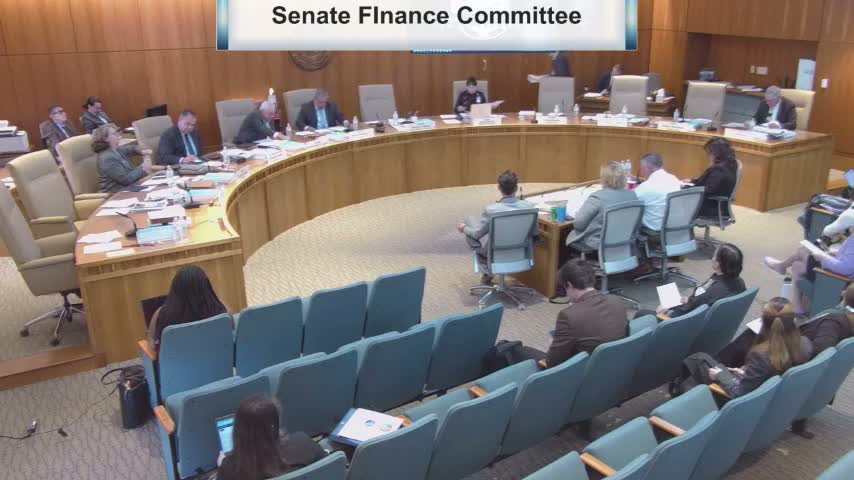
Procedurally, the committee adopted the amendment by voice and then agreed to return the bill as a committee substitute this afternoon for formal consideration and a vote. The bill was rolled over to be returned with a substitute rather than voted out immediately.
The committee directed staff to consider tribal-entity language so the bill's text includes tribes in a way that does not unintentionally bind tribal sovereignty; the chair and sponsor agreed to revisit that language and handle it by voice amendment or on the floor to avoid holding the bill in committee.
What happens next: senators agreed to bring a committee substitute on the afternoon calendar with the adopted amendments and to continue the technical work on tribal language and any remaining drafting questions.