
Senate committee advances bill to bar outside armed interference and add civil remedies for voter intimidation
Get AI-powered insights, summaries, and transcripts
Sign Up Free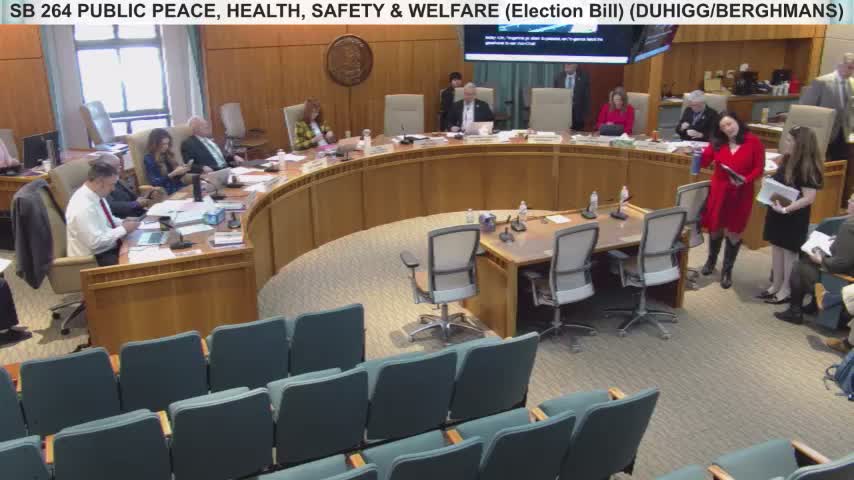
Summary
The Senate Rules Committee advanced a substitute to SB 264 to criminalize and civilly penalize unlawful interference in New Mexico elections, add a narrowly defined ‘under color of law’ standard, and create emergency electronic ballot transmission for displaced voters; substitute passed 5–3.
An amended proposal to tighten state protections against outside interference in elections moved forward from the New Mexico Senate Rules Committee on a 5–3 vote after hours of testimony and debate.
The substitute for Senate Bill 264 would add new statutory definitions (including an "under color of law" standard and a defined "peace officer"), criminalize deliberate efforts to bring troops or armed persons to polling sites or within 50 feet of ballot drop boxes during the voting period, and create both criminal penalties and civil enforcement. The sponsor said New Mexico ranks first in MIT’s Elections Performance Index and argued the bill gives the state tools to block unlawful federal or other interference amid recent national rhetoric questioning state elections.
Under the substitute, deliberate interference can be prosecuted as a fourth-degree felony (statute in the substitute describes penalties of up to 18 months in jail and a $5,000 fine) and courts would be able to award civil penalties of $5,000 to $50,000 per violation. The measure also creates expedited civil procedures and grants standing to certain voters and officials to sue when specified elements (for example, intentional obstruction or intimidation as defined in statute) are met.
Secretary of State Maggie Toluse Oliver described the bill’s emergency-election provision as modeled on procedures used for military and overseas voters: displaced voters in a county under an emergency could access a secure portal to mark and transmit a ballot to their home county clerk, and counties would be supported by the secretary of state’s "go kits" to maintain electronic access when local offices are disrupted.
Supporters — including Common Cause New Mexico and the Center for Civic Policy — said the bill would protect voters and election workers from intimidation. "Any eligible voter that wants to vote and cast their ballot should be able to without barrier or intimidation," Molly Schwenk of Common Cause said in testimony.
Opponents and some senators said the bill was posted late and that many rural county clerks had not reviewed the substitute; concerns centered on operational logistics for rural counties (how displaced voters would receive and return emergency electronic ballots) and increased litigation and insurance costs for cash-strapped counties if new private plaintiff remedies lead to more suits. Larry Sontag, speaking as a Bernalillo County voter, urged the committee to slow the process so clerks could weigh in.
Committee debate focused on the statutory definitions and the intent element for the new obstruction offense: sponsors and the secretary of state said accidental blockages (for example, a wreck that blocks a single road) would not meet the intent requirement, while deliberate roadblocks or the deployment of armed federal agents, if unlawfully ordered, would be covered.
At the committee’s conclusion, Senator Bergman moved the substitute forward and the clerk recorded a roll-call tally the chair characterized as 5 yes and 3 no, allowing the committee substitute to advance toward the Judiciary Committee for further consideration.
The committee record shows statutory references to federal criminal statutes cited by sponsors as models, and the substitute explicitly states that nothing in the bill authorizes conduct otherwise prohibited by federal law.